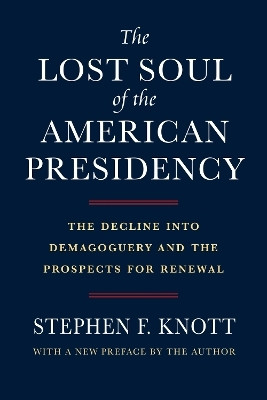
The Lost Soul of the American Presidency(English, Paperback, Knott Stephen F.)
- Knott Stephen F.
Paperback & Hardcover deals ―
Amazon IndiaGOFlipkart ₹ 2519SnapdealGOSapnaOnlineGOJain Book AgencyGOBooks Wagon₹209Book ChorGOCrosswordGODC BooksGOe-book & Audiobook deals ―
Amazon India GOGoogle Play Books GOAudible GO* Price may vary from time to time.
* GO = We're not able to fetch the price (please check manually visiting the website).
Know about the book -
The Lost Soul of the American Presidency(English, Paperback, Knott Stephen F.) is written by Knott Stephen F. and published by University Press of Kansas. It's available with International Standard Book Number or ISBN identification 0700630392 (ISBN 10) and 9780700630394 (ISBN 13).
The American presidency is not what it once was. Nor, Stephen F. Knott contends, what it was meant to be. Taking on an issue as timely as Donald Trump's latest tweet and old as the American republic, the distinguished presidential scholar documents the devolution of the American presidency from the neutral, unifying office envisioned by the framers of the Constitution into the demagogic, partisan entity of our day. The presidency of popular consent, or the majoritarian presidency that we have today, far predates its current incarnation. The executive office as James Madison, George Washington, and Alexander Hamilton conceived it would be a source of national pride and unity, a check on the tyranny of the majority, and a neutral guarantor of the nation's laws. The Lost Soul of the American Presidency shows how Thomas Jefferson's 'Revolution of 1800' remade the presidency, paving the way for Andrew Jackson to elevate 'majority rule' into an unofficial constitutional principle-and contributing to the disenfranchisement, and worse, of African Americans and Native Americans. In Woodrow Wilson, Knott finds a worthy successor to Jefferson and Jackson. More than any of his predecessors, Wilson altered the nation's expectations of what a president could be expected to achieve, putting in place the political machinery to support a 'presidential government.' As difficult as it might be to recover the lost soul of the American presidency, Knott reminds us of presidents who resisted pandering to public opinion and appealed to our better angels-George Washington, John Quincy Adams, Abraham Lincoln, and William Howard Taft, among others-whose presidencies suggest an alternative and offer hope for the future of the nation's highest office.
