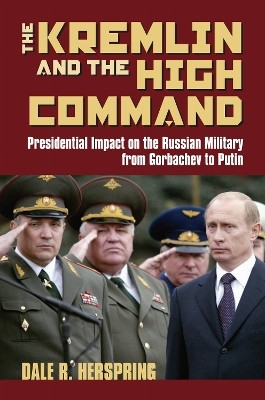
The Kremlin and the High Command(English, Hardcover, Herspring Dale R.)
- Herspring Dale R.
Paperback & Hardcover deals ―
Amazon IndiaGOFlipkart ₹ 4590SnapdealGOSapnaOnlineGOJain Book AgencyGOBooks Wagon₹619Book ChorGOCrosswordGODC BooksGOe-book & Audiobook deals ―
Amazon India GOGoogle Play Books GOAudible GO* Price may vary from time to time.
* GO = We're not able to fetch the price (please check manually visiting the website).
Know about the book -
The Kremlin and the High Command(English, Hardcover, Herspring Dale R.) is written by Herspring Dale R. and published by University Press of Kansas. It's available with International Standard Book Number or ISBN identification 0700614672 (ISBN 10) and 9780700614677 (ISBN 13).
Throughout its existence, the Red Army was viewed as a formidable threat. By the end of the Cold War, however, it had become the weakest link in the Soviet Union's power structure. Always subordinate to the Communist Party, the military in 1991 suddenly found itself answering instead to the president of a democratic state. Dale Herspring closely examines how that relationship influenced the military's viability in the new Russian Federation. Herspring's book is the first to assess the relationship between the Russian military and the political leadership under Presidents Mikhail Gorbachev, Boris Yeltsin, and Vladimir Putin. He depicts an outmoded and demoralized military force still struggling to free itself from Cold War paradigms, while failing to confront not only debacles in Afghanistan and Chechnya but also a rise in crime and corruption within the ranks. He reveals how Gorbachev neglected the military to save Russia from internal collapse and how Yeltsin reneged on continuing promises of support. And, while Putin claims a better understanding of the armed forces, he has severely tightened his control over the military while monitoring its struggle toward modernization. Herspring argues that presidential leadership - or a significant lack thereof - has been the key variable determining the kind of military Russia puts in the field. It has been up to the president to ensure that the high command makes a successful transition to the new polity - otherwise combat readiness will decline and generals and admirals could become politicized. By focusing on how the high command has reacted to each president's decisions and leadership style, Herspring shows that, in spite of the continued importance of the military's bureaucratic structure, personality factors have assumed a much more important role than in the past. ""The Kremlin and the High Command"" provides the most complete analysis to date of the Russian president's influence on the Russian officer corps, the soldiers they lead, and their army's combat readiness. It also suggests how the often fraught relationship between the president and the high command must evolve if the Russian Federation is to become a truly democratic nation.
