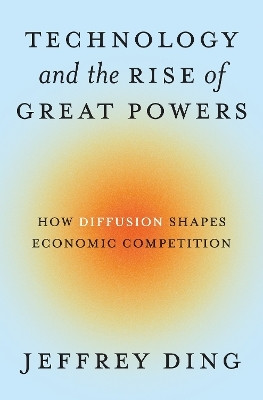
Technology and the Rise of Great Powers(English, Paperback, Ding Jeffrey)
- Ding Jeffrey
Paperback & Hardcover deals ―
Amazon IndiaGOFlipkart ₹ 1959SnapdealGOSapnaOnlineGOJain Book AgencyGOBooks Wagon₹161Book ChorGOCrosswordGODC BooksGOe-book & Audiobook deals ―
Amazon India GOGoogle Play Books GOAudible GO* Price may vary from time to time.
* GO = We're not able to fetch the price (please check manually visiting the website).
Know about the book -
Technology and the Rise of Great Powers(English, Paperback, Ding Jeffrey) is written by Ding Jeffrey and published by Princeton University Press. It's available with International Standard Book Number or ISBN identification 0691260346 (ISBN 10) and 9780691260341 (ISBN 13).
A novel theory of how technological revolutions affect the rise and fall of great powers When scholars and policymakers consider how technological advances affect the rise and fall of great powers, they draw on theories that center the moment of innovation-the eureka moment that sparks astonishing technological feats. In this book, Jeffrey Ding offers a different explanation of how technological revolutions affect competition among great powers. Rather than focusing on which state first introduced major innovations, he investigates why some states were more successful than others at adapting and embracing new technologies at scale. Drawing on historical case studies of past industrial revolutions as well as statistical analysis, Ding develops a theory that emphasizes institutional adaptations oriented around diffusing technological advances throughout the entire economy. Examining Britain's rise to preeminence in the First Industrial Revolution, America and Germany's overtaking of Britain in the Second Industrial Revolution, and Japan's challenge to America's technological dominance in the Third Industrial Revolution (also known as the "information revolution"), Ding illuminates the pathway by which these technological revolutions influenced the global distribution of power and explores the generalizability of his theory beyond the given set of great powers. His findings bear directly on current concerns about how emerging technologies such as AI could influence the US-China power balance.
