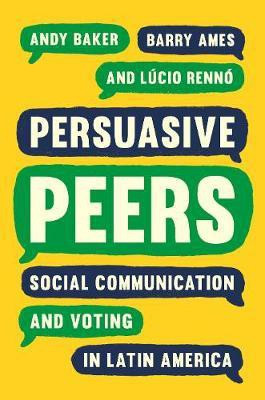
Persuasive Peers(English, Hardcover, Baker Andy)
- Baker Andy
Paperback & Hardcover deals ―
Amazon IndiaGOFlipkart ₹ 10036SnapdealGOSapnaOnlineGOJain Book AgencyGOBooks Wagon₹333Book ChorGOCrosswordGODC BooksGOe-book & Audiobook deals ―
Amazon India GOGoogle Play Books GOAudible GO* Price may vary from time to time.
* GO = We're not able to fetch the price (please check manually visiting the website).
Know about the book -
Persuasive Peers(English, Hardcover, Baker Andy) is written by Baker Andy and published by Princeton University Press. It's available with International Standard Book Number or ISBN identification 0691205787 (ISBN 10) and 9780691205786 (ISBN 13).
How voting behavior in Latin America is influenced by social networks and everyday communication among peers In Latin America's new democracies, political parties and mass partisanship are not deeply entrenched, leaving many votes up for grabs during election campaigns. In a typical presidential election season, between one-quarter and one-half of all voters-figures unheard of in older democracies-change their voting intentions across party lines in the months before election day. Advancing a new theory of Latin American voting behavior, Persuasive Peers argues that political discussions within informal social networks among family members, friends, neighbors, coworkers, and acquaintances explain this volatility and exert a major influence on final voting choices. Relying on unique survey and interview data from Latin America, the authors show that weakly committed voters defer to their politically knowledgeable peers, creating vast amounts of preference change as political campaigns unfold. Peer influences also matter for unwavering voters, who tend to have social contacts that reinforce their voting intentions. Social influence increases political conformity among voters within neighborhoods, states, and even entire regions, and the authors illustrate how party machines use the social topography of electorates to buy off well-connected voters who can magnify the impact of the payoff. Persuasive Peers demonstrates how everyday communication shapes political outcomes in Latin America's less-institutionalized democracies.
