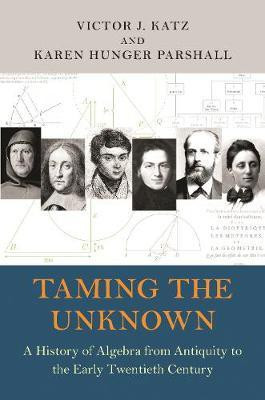
Taming the Unknown(English, Paperback, Katz Victor J.)
- Katz Victor J.
Paperback & Hardcover deals ―
Amazon IndiaGOFlipkart ₹ 5698SnapdealGOSapnaOnlineGOJain Book AgencyGOBooks Wagon₹1,056Book ChorGOCrosswordGODC BooksGOe-book & Audiobook deals ―
Amazon India GOGoogle Play Books GOAudible GO* Price may vary from time to time.
* GO = We're not able to fetch the price (please check manually visiting the website).
Know about the book -
Taming the Unknown(English, Paperback, Katz Victor J.) is written by Katz Victor J. and published by Princeton University Press. It's available with International Standard Book Number or ISBN identification 0691204071 (ISBN 10) and 9780691204079 (ISBN 13).
What is algebra? For some, it is an abstract language of x's and y's. For mathematics majors and professional mathematicians, it is a world of axiomatically defined constructs like groups, rings, and fields. Taming the Unknown considers how these two seemingly different types of algebra evolved and how they relate. Victor Katz and Karen Parshall explore the history of algebra, from its roots in the ancient civilizations of Egypt, Mesopotamia, Greece, China, and India, through its development in the medieval Islamic world and medieval and early modern Europe, to its modern form in the early twentieth century. Defining algebra originally as a collection of techniques for determining unknowns, the authors trace the development of these techniques from geometric beginnings in ancient Egypt and Mesopotamia and classical Greece. They show how similar problems were tackled in Alexandrian Greece, in China, and in India, then look at how medieval Islamic scholars shifted to an algorithmic stage, which was further developed by medieval and early modern European mathematicians. With the introduction of a flexible and operative symbolism in the sixteenth and seventeenth centuries, algebra entered into a dynamic period characterized by the analytic geometry that could evaluate curves represented by equations in two variables, thereby solving problems in the physics of motion. This new symbolism freed mathematicians to study equations of degrees higher than two and three, ultimately leading to the present abstract era. Taming the Unknown follows algebra's remarkable growth through different epochs around the globe.
