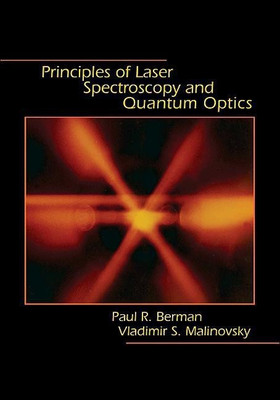
Principles of Laser Spectroscopy and Quantum Optics(English, Hardcover, Berman Paul R.)
- Berman Paul R.
Paperback & Hardcover deals ―
Amazon IndiaGOFlipkart ₹ 16129SnapdealGOSapnaOnlineGOJain Book AgencyGOBooks Wagon₹944Book ChorGOCrosswordGODC BooksGOe-book & Audiobook deals ―
Amazon India GOGoogle Play Books GOAudible GO* Price may vary from time to time.
* GO = We're not able to fetch the price (please check manually visiting the website).
Know about the book -
Principles of Laser Spectroscopy and Quantum Optics(English, Hardcover, Berman Paul R.) is written by Berman Paul R. and published by Princeton University Press. It's available with International Standard Book Number or ISBN identification 0691140561 (ISBN 10) and 9780691140568 (ISBN 13).
Principles of Laser Spectroscopy and Quantum Optics is an essential textbook for graduate students studying the interaction of optical fields with atoms. It also serves as an ideal reference text for researchers working in the fields of laser spectroscopy and quantum optics. The book provides a rigorous introduction to the prototypical problems of radiation fields interacting with two- and three-level atomic systems. It examines the interaction of radiation with both atomic vapors and condensed matter systems, the density matrix and the Bloch vector, and applications involving linear absorption and saturation spectroscopy. Other topics include hole burning, dark states, slow light, and coherent transient spectroscopy, as well as atom optics and atom interferometry. In the second half of the text, the authors consider applications in which the radiation field is quantized. Topics include spontaneous decay, optical pumping, sub-Doppler laser cooling, the Heisenberg equations of motion for atomic and field operators, and light scattering by atoms in both weak and strong external fields. The concluding chapter offers methods for creating entangled and spin-squeezed states of matter.Instructors can create a one-semester course based on this book by combining the introductory chapters with a selection of the more advanced material. A solutions manual is available to teachers. * Rigorous introduction to the interaction of optical fields with atoms * Applications include linear and nonlinear spectroscopy, dark states, and slow light * Extensive chapter on atom optics and atom interferometry * Conclusion explores entangled and spin-squeezed states of matter * Solutions manual (available only to teachers)
