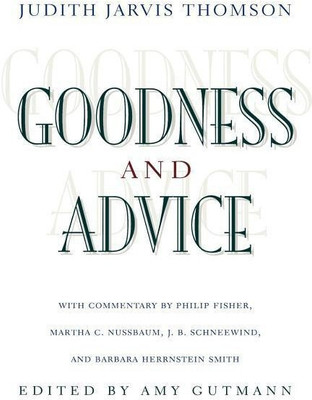
Goodness and Advice(English, Paperback, Thomson Judith Jarvis)
- Thomson Judith Jarvis
Paperback & Hardcover deals ―
Amazon IndiaGOFlipkart ₹ 4916SnapdealGOSapnaOnlineGOJain Book AgencyGOBooks Wagon₹365Book ChorGOCrosswordGODC BooksGOe-book & Audiobook deals ―
Amazon India GOGoogle Play Books GOAudible GO* Price may vary from time to time.
* GO = We're not able to fetch the price (please check manually visiting the website).
Know about the book -
Goodness and Advice(English, Paperback, Thomson Judith Jarvis) is written by Thomson Judith Jarvis and published by Princeton University Press. It's available with International Standard Book Number or ISBN identification 0691114730 (ISBN 10) and 9780691114736 (ISBN 13).
How should we live? What do we owe to other people? In Goodness and Advice, the eminent philosopher Judith Jarvis Thomson explores how we should go about answering such fundamental questions. In doing so, she makes major advances in moral philosophy, pointing to some deep problems for influential moral theories and describing the structure of a new and much more promising theory. Thomson begins by lamenting the prevalence of the idea that there is an unbridgeable gap between fact and value--that to say something is good, for example, is not to state a fact, but to do something more like expressing an attitude or feeling. She sets out to challenge this view, first by assessing the apparently powerful claims of Consequentialism. Thomson makes the striking argument that this familiar theory must ultimately fail because its basic requirement--that people should act to bring about the "most good"--is meaningless. It rests on an incoherent conception of goodness, and supplies, not mistaken advice, but no advice at all. Thomson then outlines the theory that she thinks we should opt for instead.This theory says that no acts are, simply, good: an act can at most be good in one or another way--as, for example, good for Smith or for Jones. What we ought to do is, most importantly, to avoid injustice; and whether an act is unjust is a function both of the rights of those affected, including the agent, and of how good or bad the act is for them. The book, which originated in the Tanner lectures that Thomson delivered at Princeton University's Center for Human Values in 1999, includes two chapters by Thomson ("Goodness" and "Advice"), provocative comments by four prominent scholars--Martha Nussbaum, Jerome Schneewind, Philip Fisher, and Barbara Herrnstein Smith--and replies by Thomson to those comments.
