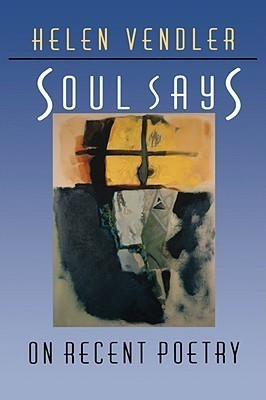
Soul Says(English, Paperback, Vendler Helen)
- Vendler Helen
Paperback & Hardcover deals ―
Amazon IndiaGOFlipkart ₹ 3373SnapdealGOSapnaOnlineGOJain Book AgencyGOBooks Wagon₹233Book ChorGOCrosswordGODC BooksGOe-book & Audiobook deals ―
Amazon India GOGoogle Play Books GOAudible GO* Price may vary from time to time.
* GO = We're not able to fetch the price (please check manually visiting the website).
Know about the book -
Soul Says(English, Paperback, Vendler Helen) is written by Vendler Helen and published by Harvard University Press. It's available with International Standard Book Number or ISBN identification 0674821475 (ISBN 10) and 9780674821477 (ISBN 13).
"Vendler again demonstrates-if proof were needed-why she is the finest poetry reviewer in the country." -Boston Globe The renowned critic of Stevens, Keats, and Herbert turns an incisive gaze to her contemporaries, from Louise Glueck to Rita Dove. Lyric poetry, says the incomparable Helen Vendler, is defined by immediacy. If the novel aspires to represent life in all its complexity, with characters woven into their manifold historical and sociological contexts, lyric captures the human being in the here and now: as a fragment, an eruption, or a "set of warring passions independent of time and space." Fiction constructs selfhood, but poetry gives us the soul. Drawing its title from a poem by Jorie Graham, Soul Says collects twenty-one of Vendler's best essays on the force, beauty, and formal intricacies of late-twentieth-century verse. Whether meditating on Graham's roving cinematography of the mind, anatomizing the inversions of classical elegy in Allen Ginsberg's "Kaddish," or exploring Charles Simic's sinister landscapes, Vendler makes difficult poetry accessible and helps readers appreciate the depth and richness of even the simplest texts. Through her perceptive eyes we see how lyric poetry, pulsing with musicality, uses arrangement, pacing, and metaphor to illuminate the hidden corners of inner life. Inner life cannot be entirely disentangled from the history: Rita Dove cannot write as if she were unencumbered by her life as a Black woman in America any more than Seamus Heaney can avoid his experience as a Northern Irishman who lived through the Troubles. But Vendler's painstaking attention to form-Dove's angular stanzas, Heaney's organicism-brilliantly reveals how such great poets exceed the sum of their biographical parts. To read their poetry is to see their lives transfigured, and, in the process, to reconsider our own.
