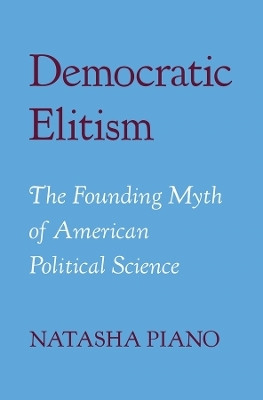
Democratic Elitism(English, Hardcover, Piano Natasha)
- Piano Natasha
Paperback & Hardcover deals ―
Amazon IndiaGOFlipkart ₹ 5681SnapdealGOSapnaOnlineGOJain Book AgencyGOBooks Wagon₹716Book ChorGOCrosswordGODC BooksGOe-book & Audiobook deals ―
Amazon India GOGoogle Play Books GOAudible GO* Price may vary from time to time.
* GO = We're not able to fetch the price (please check manually visiting the website).
Know about the book -
Democratic Elitism(English, Hardcover, Piano Natasha) is written by Piano Natasha and published by Harvard University Press. It's available with International Standard Book Number or ISBN identification 0674295374 (ISBN 10) and 9780674295377 (ISBN 13).
A searing argument-and work of meticulous scholarship-about how American political scientists misinterpreted the elite theory of democracy and in so doing made our political system vulnerable to oligarchic takeover. Do competitive elections secure democracy, or might they undermine it by breeding popular disillusionment with liberal norms and procedures? The so-called Italian School of Elitism, comprising Vilfredo Pareto, Gaetano Mosca, and Robert Michels, voiced this very concern. They feared that defining democracy exclusively through representative practices creates unrealistic expectations of what elections can achieve, generating mass demoralization and disillusionment with popular government. The Italian School's concern has gone unheeded, even as their elite theory has been foundational for political science in the United States. Democratic Elitism argues that scholars have misinterpreted the Italians as conservative, antidemocratic figures who championed the equation of democracy with representative practices to restrain popular participation in politics. Natasha Piano contends not only that the Italian School's thought has been distorted but also that theorists have ignored its main objective: to contain demagogues and plutocrats who prey on the cynicism of the masses. We ought to view these thinkers not as elite theorists of democracy but as democratic theorists of elitism. The Italian School's original writings do not reject electoral politics; they emphasize the power and promise of democracy beyond the ballot. Elections undoubtedly are an essential component of functioning democracies, but in order to preserve their legitimacy we must understand their true capacities and limitations. It is past time to dispel the delusion that we need only elections to solve political crises, or else mass publics, dissatisfied with the status quo, will fall deeper into the arms of authoritarians who capture and pervert formal democratic institutions to serve their own ends.
