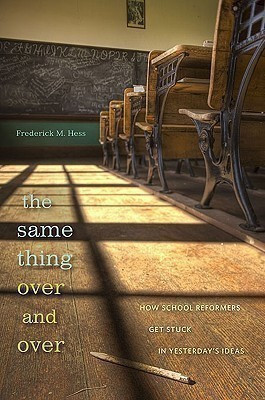
The Same Thing Over and Over(English, Hardcover, Hess Frederick M.)
- Hess Frederick M.
Paperback & Hardcover deals ―
Amazon IndiaGOFlipkart ₹ 4285SnapdealGOSapnaOnlineGOJain Book AgencyGOBooks Wagon₹320Book ChorGOCrosswordGODC BooksGOe-book & Audiobook deals ―
Amazon India GOGoogle Play Books GOAudible GO* Price may vary from time to time.
* GO = We're not able to fetch the price (please check manually visiting the website).
Know about the book -
The Same Thing Over and Over(English, Hardcover, Hess Frederick M.) is written by Hess Frederick M. and published by Harvard University Press. It's available with International Standard Book Number or ISBN identification 0674055829 (ISBN 10) and 9780674055827 (ISBN 13).
In this genial and challenging overview of endless debates over school reform, Rick Hess shows that even bitter opponents in debates about how to improve schools agree on much more than they realize-and that much of it must change radically. Cutting through the tangled thickets of right- and left-wing dogma, he clears the ground for transformation of the American school system. Whatever they think of school vouchers or charter schools, teacher merit pay or bilingual education, most educators and advocates take many other things for granted. The one-teacher-one-classroom model. The professional full-time teacher. Students grouped in age-defined grades. The nine-month calendar. Top-down local district control. All were innovative and exciting-in the nineteenth century. As Hess shows, the system hasn't changed since most Americans lived on farms and in villages, since school taught you to read, write, and do arithmetic, and since only an elite went to high school, let alone college. Arguing that a fundamentally nineteenth century system can't be right for a twenty-first century world, Hess suggests that uniformity gets in the way of quality, and urges us to create a much wider variety of schools, to meet a greater range of needs for different kinds of talents, needed by a vastly more complex and demanding society.
