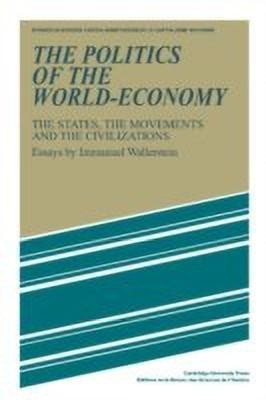
The Politics of the World-Economy(English, Paperback, Wallerstein Immanuel)
- Wallerstein Immanuel
Paperback & Hardcover deals ―
Amazon IndiaGOFlipkart ₹ 2383SnapdealGOSapnaOnlineGOJain Book AgencyGOBooks Wagon₹175Book ChorGOCrosswordGODC BooksGOe-book & Audiobook deals ―
Amazon India GOGoogle Play Books GOAudible GO* Price may vary from time to time.
* GO = We're not able to fetch the price (please check manually visiting the website).
Know about the book -
The Politics of the World-Economy(English, Paperback, Wallerstein Immanuel) is written by Wallerstein Immanuel and published by Cambridge University Press. It's available with International Standard Book Number or ISBN identification 0521277604 (ISBN 10) and 9780521277600 (ISBN 13).
In these essays, written (with one exception) between 1978 and 1982, Immanuel Wallerstein elaborates on the political and theoretical implications of the world-systems perspective outlined in his celebrated books The Modern World-System and The Capitalist World-Economy. Whereas those books centred on the historical development of the modern world-system, the essays in this volume explore the nature of world politics in the light of Wallerstein's analysis of the world-system and capitalist world-economy. Throughout, the essays offer new perspectives on the central issues of political debate today: the roles of the USA and the USSR in the world-system, the relations of the Third World states to the capitalist 'core', and the potential for socialist or revolutionary change. Different sections deal with the three major political institutions of the modern world-system: the states, the antisystemic movements, and the civilizations. The states are a classic rubric of political analysis. For Wallerstein, the limits of sovereignty are at least as important as the powers - these limits deriving from the obligatory location of the modern state in the interstate system. Social movements are a second classic rubric. For Wallerstein, the principal questions are the degree to which such movements are antisystemic, and the dilemmas state power poses for antisystemic movements. Civilizations, in contrast, are not normally seen as a political institution. That however is for Wallerstein the key to the analysis of their role in the contemporary world, and thereby a key to understanding the politics of social science.
