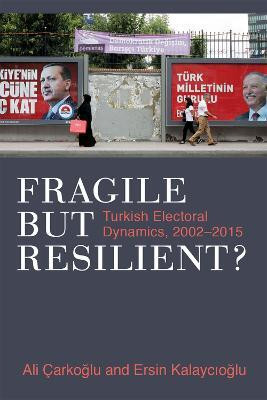
Fragile but Resilient?(English, Hardcover, Carkoglu Ali Prof.)
- Carkoglu Ali Prof.
Paperback & Hardcover deals ―
Amazon IndiaGOFlipkart ₹ 10891SnapdealGOSapnaOnlineGOJain Book AgencyGOBooks Wagon₹8,136Book ChorGOCrosswordGODC BooksGOe-book & Audiobook deals ―
Amazon India GOGoogle Play Books GOAudible GO* Price may vary from time to time.
* GO = We're not able to fetch the price (please check manually visiting the website).
Know about the book -
Fragile but Resilient?(English, Hardcover, Carkoglu Ali Prof.) is written by Carkoglu Ali Prof. and published by The University of Michigan Press. It's available with International Standard Book Number or ISBN identification 0472132431 (ISBN 10) and 9780472132430 (ISBN 13).
Ersin Kalaycioglu and Ali Carkoglu, who conducted surveys comparable to the American National Election Survey for the 2002 and 2015 national elections in Turkey, chart the dynamics that brought the pro-Islamist conservative Justice and Development Party (Adalet ve Kalkinma Partisi-AKP) to power in 2002, and that continue to influence electoral politics. The authors trace the uneven course of democratization in Turkey, as revealed through elections, since the first competitive, multi-party elections in 1950. Since the market liberalization reforms of 1980, Turkey has been rapidly evolving from a closed, agricultural, comparatively underdeveloped polity into an open and industrial state primarily integrated with the global economy. Kalaycioglu and Carkoglu analyze different dimensions of five elections surveys in 2002-2015 period to show how the consequent socio-economic changes and traditional socio-cultural divisions have affected elections, political parties, and individual voters. The authors conclude that the historical-cultural divide between rural, peripheral, conservative groups and more urban, centrist, and modernized groups not only persists but shapes elections more than ever. This book not only provides an original comprehensive and critical evaluation of the Turkish electoral and party politics, it also offers a case study of voting behavior in a state undergoing both democratization and market liberalization in a rapidly changing and volatile international environment.
