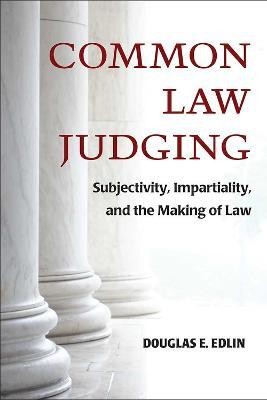
Common Law Judging(English, Hardcover, Edlin Douglas E.)
- Edlin Douglas E.
Paperback & Hardcover deals ―
Amazon IndiaGOFlipkart ₹ 5862SnapdealGOSapnaOnlineGOJain Book AgencyGOBooks Wagon₹376Book ChorGOCrosswordGODC BooksGOe-book & Audiobook deals ―
Amazon India GOGoogle Play Books GOAudible GO* Price may vary from time to time.
* GO = We're not able to fetch the price (please check manually visiting the website).
Know about the book -
Common Law Judging(English, Hardcover, Edlin Douglas E.) is written by Edlin Douglas E. and published by The University of Michigan Press. It's available with International Standard Book Number or ISBN identification 0472130021 (ISBN 10) and 9780472130023 (ISBN 13).
Are judges supposed to be objective? Citizens, scholars, and legal professionals commonly assume that subjectivity and objectivity are opposites, with the corollary that subjectivity is a vice and objectivity is a virtue. These assumptions underlie passionate debates over adherence to original intent and judicial activism. In Common Law Judging, Douglas Edlin challenges these widely held assumptions by reorienting the entire discussion. Rather than analyze judging in terms of objectivity and truth, he argues that we should instead approach the role of a judge's individual perspective in terms of intersubjectivity and validity. Drawing upon Kantian aesthetic theory as well as case law, legal theory, and constitutional theory, Edlin develops a new conceptual framework for the respective roles of the individual judge and of the judiciary as an institution, as well as the relationship between them, as integral parts of the broader legal and political community. Specifically, Edlin situates a judge's subjective responses within a form of legal reasoning and reflective judgment that must be communicated to different audiences. Edlin concludes that the individual values and perspectives of judges are indispensable both to their judgments in specific cases and to the independence of the courts. According to the common law tradition, judicial subjectivity is a virtue, not a vice.
