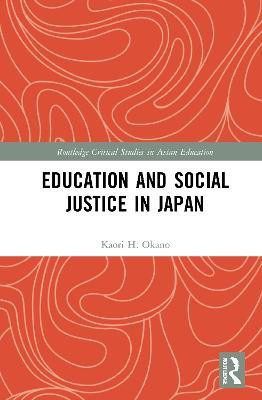
Education and Social Justice in Japan(English, Hardcover, Okano Kaori H.)
- Okano Kaori H.
Paperback & Hardcover deals ―
Amazon IndiaGOFlipkart ₹ 10372SnapdealGOSapnaOnlineGOJain Book AgencyGOBooks Wagon₹8,992Book ChorGOCrosswordGODC BooksGOe-book & Audiobook deals ―
Amazon India GOGoogle Play Books GOAudible GO* Price may vary from time to time.
* GO = We're not able to fetch the price (please check manually visiting the website).
Know about the book -
Education and Social Justice in Japan(English, Hardcover, Okano Kaori H.) is written by Okano Kaori H. and published by Taylor & Francis Ltd. It's available with International Standard Book Number or ISBN identification 0415832527 (ISBN 10) and 9780415832526 (ISBN 13).
This book is an up-to-date critical examination of schooling in Japan by an expert in this field. It focuses on developments in the last two decades, with a particular interest in social justice. Japan has experienced slow economic growth, changed employment practices, population decline, an aging society, and an increasingly multi-ethnic population resulting from migration. It has faced a call to respond to the rhetoric of globalization and to concerns in childhood poverty in the perceived affluence. In education we have seen developments responding to these challenges in national and local educational policies, as well as in school-level practices. What are the most significant developments in schooling of the last two decades? Why have these developments emerged, and how will they affect youth and society as a whole? How can we best interpret social justice implications of these developments in terms of both distributive justice and the politics of difference? To what extent have the shifts advanced the interests of disadvantaged groups? This book shows that, compared to three decades ago, the system of education increasingly acknowledges the need to address student diversity of all kinds, and delivers options that are more varied and flexible. But interest in social justice in education has tended to centre on the distribution of education (who gets how much of schooling), with fewer questions raised about the content of schooling that continues to advantage the already advantaged. Written in a highly accessible style, and aimed at scholars and students in the fields of comparative education, sociology of education and Japanese studies, this book illuminates changing policies and cumulative adjustments in the daily practice of schooling, as well as how various groups in society make sense of these changes.
