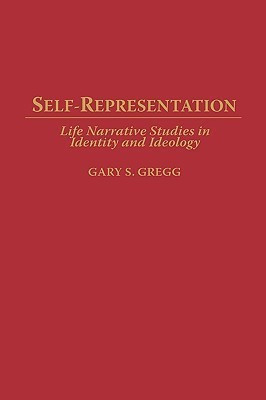
Self-Representation - Life Narrative Studies in Identity and Ideology(English, Hardcover, Gregg Gary S.)
- Gregg Gary S.
Paperback & Hardcover deals ―
Amazon IndiaGOFlipkart ₹ 11473SnapdealGOSapnaOnlineGOJain Book AgencyGOBooks Wagon₹425Book ChorGOCrosswordGODC BooksGOe-book & Audiobook deals ―
Amazon India GOGoogle Play Books GOAudible GO* Price may vary from time to time.
* GO = We're not able to fetch the price (please check manually visiting the website).
Know about the book -
Self-Representation - Life Narrative Studies in Identity and Ideology(English, Hardcover, Gregg Gary S.) is written by Gregg Gary S. and published by Bloomsbury Publishing Plc. It's available with International Standard Book Number or ISBN identification 0313278628 (ISBN 10) and 9780313278624 (ISBN 13).
This innovative work offers a new approach to the study of self-representation, drawing on both the older study of lives tradition in personality psychology and recent work in narrative psychology. Gary S. Gregg presents a generative theory of self-representation, applying methods of symbolic analysis developed by cultural anthropologists to the texts of life-historical interviews. This model accounts for the continual shifting of identity among contradictory surface discourses about the self, as it shows how each discourse is defined as a reconfiguration of a stable cluster of deep structurally-ambigious elements. Gregg not only examines the nature of narrative, but also addresses more mainstream issues in cognitive science, such as: How is knowledge of the self and its social world represented? What are the elementary units of self-cognition? How are cognition and affect linked? After a brief introduction, the book raises critical questions about self-representation by presenting re-analyses of two famous case studies--Freud's Rat Man and Mack and Larry from The Authoritarian Personality--and initial observations from Gregg's fieldwork in Morocco. A theoretical chapter then introduces the notion of structured ambiguity, which enables a person to shift between identities by figure or ground-like reversals of key symbols and metaphors. Three original life-narrative analyses follow, which, with increasing complexity, develop the model via analogies to basic structures of tonal music. The work concludes with a theoretical chapter that reexamines the ideas of William James, George Herbert Mead, and Erik Erikson about the self's unity and multiplicity, and then summarizes a generative model. The book presents a compelling alternative to prevailing views of self-cognition and identity, and will be a valuable resource for courses in psychology, anthropology, and sociology, as well as an important tool for researchers and professionals in these fields.
