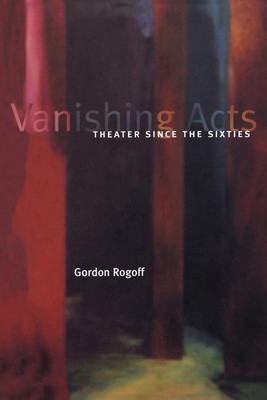
Vanishing Acts(English, Paperback, Rogoff Gordon)
- Rogoff Gordon
Paperback & Hardcover deals ―
Amazon IndiaGOFlipkart ₹ 1345SnapdealGOSapnaOnlineGOJain Book AgencyGOBooks Wagon₹921Book ChorGOCrosswordGODC BooksGOe-book & Audiobook deals ―
Amazon India GOGoogle Play Books GOAudible GO* Price may vary from time to time.
* GO = We're not able to fetch the price (please check manually visiting the website).
Know about the book -
Vanishing Acts(English, Paperback, Rogoff Gordon) is written by Rogoff Gordon and published by Yale University Press. It's available with International Standard Book Number or ISBN identification 0300087772 (ISBN 10) and 9780300087772 (ISBN 13).
In this outstanding collection of critical writings, some published here for the first time, Gordon Rogoff tells the story of live theater in America over the past forty years. His view of modern drama and its performance is rich with the insights of both a discerning critic and an individual for whom the making of theater is a passion. As Rogoff explores the topics of acting, directing, playwriting, Shakespeare productions, opera, and theater criticism, he celebrates live theater's victories over new realms while deploring the threat of imitative repertories, acting styles, and playwriting. Throughout the book he underscores his conviction that dramatic literature and performance may be taken as a book of instruction for the way we lead our lives. Rogoff ranges widely in his discussions, considering the work of Peter Brook, Robert Wilson, Ariane Mnouchkine, Samuel Beckett, Tennessee Williams, Alban Berg, and Tony Kushner among others, and the performances of such actors as Laurence Olivier, Donald Wolfit, Judi Dench, Anthony Hopkins, Dustin Hoffman, Al Pacino, Lee J. Cobb, Vanessa Redgrave, and Geraldine Page. He registers dissenting notes about the accomplishments of Joseph Papp, Eugene O'Neill, and Arthur Miller. In his concluding essay, Rogoff contends that nostalgia-"our millennial nemesis"-may be a way of forgetting rather than remembering.
