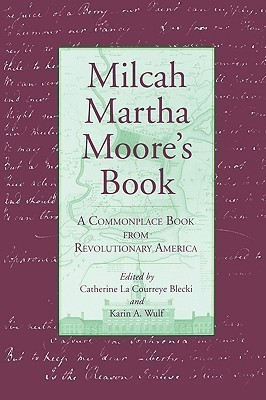
Milcah Martha Moore's Book(English, Paperback, unknown)
- unknown
Paperback & Hardcover deals ―
Amazon IndiaGOFlipkart ₹ 4049SnapdealGOSapnaOnlineGOJain Book AgencyGOBooks Wagon₹1,532Book ChorGOCrosswordGODC BooksGOe-book & Audiobook deals ―
Amazon India GOGoogle Play Books GOAudible GO* Price may vary from time to time.
* GO = We're not able to fetch the price (please check manually visiting the website).
Know about the book -
Milcah Martha Moore's Book(English, Paperback, unknown) is written by unknown and published by Pennsylvania State University Press. It's available with International Standard Book Number or ISBN identification 0271030054 (ISBN 10) and 9780271030050 (ISBN 13).
Milcah Martha Moore (1740-1829) lived and flourished in the Philadelphia area during its peak, when it was the center of commerce, politics, social life, and culture in the young republic. A well-educated woman, disowned by her Quaker Meeting for an unauthorized marriage, Moore knew and corresponded with many of the leading lights of her day. From her network of acquaintances, she created a commonplace book, which is published here for the first time. Moore compiled her commonplace book during the American Revolution, carefully selecting works of poetry and prose that she and her friends most enjoyed reading and wanted to remember. Contained are 126 works of prose and poetry by at least sixteen different authors, mostly women. Catherine Blecki and Karin Wulf have edited and reproduced the entire collection, adding helpful annotations and interpretive essays that set the collection in historical and literary context. Moore's Book will be a treasure trove for feminist and early American scholars, for it includes two of the most avidly sought-after bodies of writing from British America: sixteen new poems (twenty-four in all) by the Quaker polymath Susanna Wright and a previously lost portion of the journal kept by Elizabeth Graeme Fergusson during her trip to England. There is also a remarkable selection of pieces by Hannah Griffitts, the Quaker moralist and wit who commented on politics, society, and domesticity during the Revolution. Moore also included writings by Benjamin Franklin, Patrick Henry, and Samuel Fothergill. While scholars have speculated about the extent to which elite women exchanged ideas through reading and writing during this period, Moore's Book is the richest surviving body of evidence revealing the nature and substance of women's intellectual community in British America. The quality of the writing is high and reflects a range of popular literary genres including religious and meditational poetry, elegies, verse epistles and extempore verse, hymns, occasional poems, letters, and journal writing. Topics range from family and friends to religion and mortality, to politics and war-belying the notion that women's concerns were limited only to a domestic sphere. Taken as a whole, Moore's collection presents an unparalleled view of the interests and tastes of educated women in early America.
