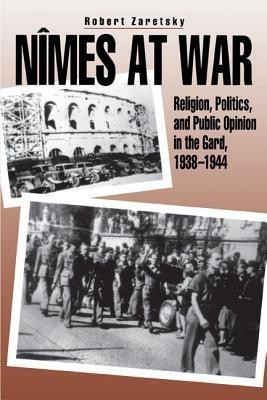
Nimes at War(English, Paperback, Zaretsky Robert)
- Zaretsky Robert
Paperback & Hardcover deals ―
Amazon IndiaGOFlipkart ₹ 4126SnapdealGOSapnaOnlineGOJain Book AgencyGOBooks Wagon₹16,156Book ChorGOCrosswordGODC BooksGOe-book & Audiobook deals ―
Amazon India GOGoogle Play Books GOAudible GO* Price may vary from time to time.
* GO = We're not able to fetch the price (please check manually visiting the website).
Know about the book -
Nimes at War(English, Paperback, Zaretsky Robert) is written by Zaretsky Robert and published by Pennsylvania State University Press. It's available with International Standard Book Number or ISBN identification 0271025883 (ISBN 10) and 9780271025889 (ISBN 13).
"Vichy will not go away. As I write, France is in the throes of the Paul Touvier affair. . . . The Touvier affair is just the most recent expression of what Henry Rousso has called the Vichy syndrome." So begins Robert Zaretsky's timely study of everyday life in France during the "dark years" of Vichy. While many studies of Vichy France have either focused on specific lives or ideas or covered the period in broad and synthetic terms, local studies such as this promise to nuance our understanding of wartime France. By concentrating on the city of Nimes and the department of the Gard, Zaretsky moves beyond generalizations concerning resistance and collaboration to consider issues of historical continuity and change within a specific local context. In the words and acts of local French men and women, he finds the character of "mentalities" in the heart of our own century. The Gard is well chosen as the focus of this study. From the sixteenth century onward, the region had been a flash point between warring Catholics and Protestants. By the early twentieth century, that tension had eased but not disappeared. Zaretsky examines the dynamics between local Protestant, Catholic, and Jewish communities, arguing that with the advent of Vichy-a regime that, if not clerical, was deeply deferential to the Catholic Church-tension and conflict resurfaced in the Gard. Nimes at War is based on a wealth of archival materials-police and prefectoral reports, official departmental documents, local secular and religious newspapers, and letters intercepted by the regime's security apparatus-much of which has only recently been opened to researchers. Zaretsky's detailed narrative will undoubtedly provoke further reconsideration of the complex and ambiguous world of Vichy.
