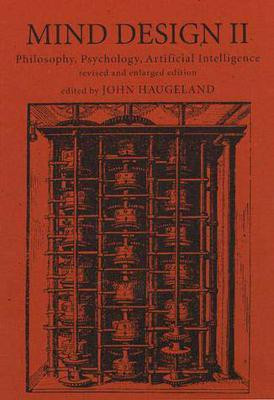
Mind Design II(English, Paperback, unknown)
- unknown
Paperback & Hardcover deals ―
Amazon IndiaGOFlipkart ₹ 3537SnapdealGOSapnaOnlineGOJain Book AgencyGOBooks Wagon₹210Book ChorGOCrosswordGODC BooksGOe-book & Audiobook deals ―
Amazon India GOGoogle Play Books GOAudible GO* Price may vary from time to time.
* GO = We're not able to fetch the price (please check manually visiting the website).
Know about the book -
Mind Design II(English, Paperback, unknown) is written by unknown and published by MIT Press Ltd. It's available with International Standard Book Number or ISBN identification 0262581531 (ISBN 10) and 9780262581530 (ISBN 13).
Mind design is the endeavor to understand mind (thinking, intellect) in terms of its design (how it is built, how it works). Unlike traditional empirical psychology, it is more oriented toward the "how" than the "what." An experiment in mind design is more likely to be an attempt to build something and make it work-as in artificial intelligence-than to observe or analyze what already exists. Mind design is psychology by reverse engineering. When Mind Design was first published in 1981, it became a classic in the then-nascent fields of cognitive science and AI. This second edition retains four landmark essays from the first, adding to them one earlier milestone (Turing's "Computing Machinery and Intelligence") and eleven more recent articles about connectionism, dynamical systems, and symbolic versus nonsymbolic models. The contributors are divided about evenly between philosophers and scientists. Yet all are "philosophical" in that they address fundamental issues and concepts; and all are "scientific" in that they are technically sophisticated and concerned with concrete empirical research. Contributors Rodney A. Brooks, Paul M. Churchland, Andy Clark, Daniel C. Dennett, Hubert L. Dreyfus, Jerry A. Fodor, Joseph Garon, John Haugeland, Marvin Minsky, Allen Newell, Zenon W. Pylyshyn, William Ramsey, Jay F. Rosenberg, David E. Rumelhart, John R. Searle, Herbert A. Simon, Paul Smolensky, Stephen Stich, A.M. Turing, Timothy van Gelder
