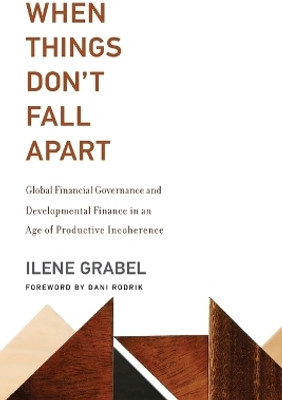
When Things Don't Fall Apart(English, Paperback, Grabel Ilene)
- Grabel Ilene
Paperback & Hardcover deals ―
Amazon IndiaGOFlipkart ₹ 2026SnapdealGOSapnaOnlineGOJain Book AgencyGOBooks Wagon₹2,519Book ChorGOCrosswordGODC BooksGOe-book & Audiobook deals ―
Amazon India GOGoogle Play Books GOAudible GO* Price may vary from time to time.
* GO = We're not able to fetch the price (please check manually visiting the website).
Know about the book -
When Things Don't Fall Apart(English, Paperback, Grabel Ilene) is written by Grabel Ilene and published by MIT Press Ltd. It's available with International Standard Book Number or ISBN identification 0262538520 (ISBN 10) and 9780262538527 (ISBN 13).
An account of the significant though gradual, uneven, disconnected, ad hoc, and pragmatic innovations in global financial governance and developmental finance induced by the global financial crisis. In When Things Don't Fall Apart, Ilene Grabel challenges the dominant view that the global financial crisis had little effect on global financial governance and developmental finance. Most observers discount all but grand, systemic ruptures in institutions and policy. Grabel argues instead that the global crisis induced inconsistent and ad hoc discontinuities in global financial governance and developmental finance that are now having profound effects on emerging market and developing economies. Grabel's chief normative claim is that the resulting incoherence in global financial governance is productive rather than debilitating. In the age of productive incoherence, a more complex, dense, fragmented, and pluripolar form of global financial governance is expanding possibilities for policy and institutional experimentation, policy space for economic and human development, financial stability and resilience, and financial inclusion. Grabel draws on key theoretical commitments of Albert Hirschman to cement the case for the productivity of incoherence. Inspired by Hirschman, Grabel demonstrates that meaningful change often emerges from disconnected, erratic, experimental, and inconsistent adjustments in institutions and policies as actors pragmatically manage in an evolving world. Grabel substantiates her claims with empirically rich case studies that explore the effects of recent crises on networks of financial governance (such as the G-20); transformations within the IMF; institutional innovations in liquidity support and project finance from the national to the transregional levels; and the "rebranding" of capital controls. Grabel concludes with a careful examination of the opportunities and risks associated with the evolutionary transformations underway.
