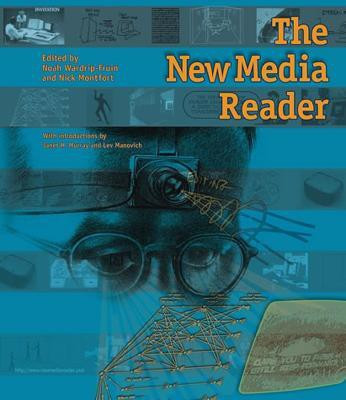
The New Media Reader(English, Hardcover, unknown)
- unknown
Paperback & Hardcover deals ―
Amazon IndiaGOFlipkart ₹ 5624SnapdealGOSapnaOnlineGOJain Book AgencyGOBooks Wagon₹1,308Book ChorGOCrosswordGODC BooksGOe-book & Audiobook deals ―
Amazon India GOGoogle Play Books GOAudible GO* Price may vary from time to time.
* GO = We're not able to fetch the price (please check manually visiting the website).
Know about the book -
The New Media Reader(English, Hardcover, unknown) is written by unknown and published by MIT Press Ltd. It's available with International Standard Book Number or ISBN identification 0262232278 (ISBN 10) and 9780262232272 (ISBN 13).
A sourcebook of historical written texts, video documentation, and working programs that form the foundation of new media. This reader collects the texts, videos, and computer programs-many of them now almost impossible to find-that chronicle the history and form the foundation of the still-emerging field of new media. General introductions by Janet Murray and Lev Manovich, along with short introductions to each of the texts, place the works in their historical context and explain their significance. The texts were originally published between World War II-when digital computing, cybernetic feedback, and early notions of hypertext and the Internet first appeared-and the emergence of the World Wide Web-when they entered the mainstream of public life. The texts are by computer scientists, artists, architects, literary writers, interface designers, cultural critics, and individuals working across disciplines. The contributors include (chronologically) Jorge Luis Borges, Vannevar Bush, Alan Turing, Ivan Sutherland, William S. Burroughs, Ted Nelson, Italo Calvino, Marshall McLuhan, Jean Baudrillard, Nicholas Negroponte, Alan Kay, Bill Viola, Sherry Turkle, Richard Stallman, Brenda Laurel, Langdon Winner, Robert Coover, and Tim Berners-Lee. The CD accompanying the book contains examples of early games, digital art, independent literary efforts, software created at universities, and home-computer commercial software. Also on the CD is digitized video, documenting new media programs and artwork for which no operational version exists. One example is a video record of Douglas Engelbart's first presentation of the mouse, word processor, hyperlink, computer-supported cooperative work, video conferencing, and the dividing up of the screen we now call non-overlapping windows; another is documentation of Lynn Hershman's Lorna, the first interactive video art installation.
