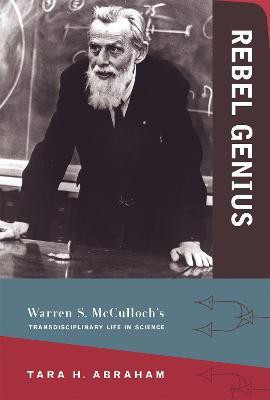
Rebel Genius(English, Hardcover, Abraham Tara)
- Abraham Tara
Paperback & Hardcover deals ―
Amazon IndiaGOFlipkart ₹ 3119SnapdealGOSapnaOnlineGOJain Book AgencyGOBooks Wagon₹853Book ChorGOCrosswordGODC BooksGOe-book & Audiobook deals ―
Amazon India GOGoogle Play Books GOAudible GO* Price may vary from time to time.
* GO = We're not able to fetch the price (please check manually visiting the website).
Know about the book -
Rebel Genius(English, Hardcover, Abraham Tara) is written by Abraham Tara and published by MIT Press Ltd. It's available with International Standard Book Number or ISBN identification 026203509X (ISBN 10) and 9780262035095 (ISBN 13).
The life and work of a scientist who spent his career crossing disciplinary boundaries-from experimental neurology to psychiatry to cybernetics to engineering. Warren S. McCulloch (1898-1969) adopted many identities in his scientific life-among them philosopher, poet, neurologist, neurophysiologist, neuropsychiatrist, collaborator, theorist, cybernetician, mentor, engineer. He was, writes Tara Abraham in this account of McCulloch's life and work, "an intellectual showman," and performed this part throughout his career. While McCulloch claimed a common thread in his work was the problem of mind and its relationship to the brain, there was much more to him than that. In Rebel Genius, Abraham uses McCulloch's life as a window on a past scientific age, showing the complex transformations that took place in American brain and mind science in the twentieth century-particularly those surrounding the cybernetics movement. Abraham describes McCulloch's early work in neuropsychiatry, and his emerging identity as a neurophysiologist. She explores his transformative years at the Illinois Neuropsychiatric Institute and his work with Walter Pitts-often seen as the first iteration of "artificial intelligence" but here described as stemming from the new tradition of mathematical treatments of biological problems. Abraham argues that McCulloch's dual identities as neuropsychiatrist and cybernetician are inseparable. He used the authority he gained in traditional disciplinary roles as a basis for posing big questions about the brain and mind as a cybernetician. When McCulloch moved to the Research Laboratory of Electronics at MIT, new practices for studying the brain, grounded in mathematics, philosophy, and theoretical modeling, expanded the relevance and ramifications of his work. McCulloch's transdisciplinary legacies anticipated today's multidisciplinary field of cognitive science.
