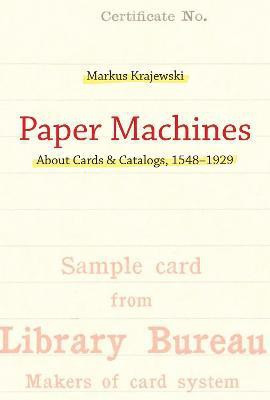
Paper Machines(English, Hardcover, Krajewski Markus)
- Krajewski Markus
Paperback & Hardcover deals ―
Amazon IndiaGOFlipkart ₹ 3060SnapdealGOSapnaOnlineGOJain Book AgencyGOBooks Wagon₹8,992Book ChorGOCrosswordGODC BooksGOe-book & Audiobook deals ―
Amazon India GOGoogle Play Books GOAudible GO* Price may vary from time to time.
* GO = We're not able to fetch the price (please check manually visiting the website).
Know about the book -
Paper Machines(English, Hardcover, Krajewski Markus) is written by Krajewski Markus and published by MIT Press Ltd. It's available with International Standard Book Number or ISBN identification 0262015897 (ISBN 10) and 9780262015899 (ISBN 13).
Why the card catalog-a "paper machine" with rearrangeable elements-can be regarded as a precursor of the computer. Today on almost every desk in every office sits a computer. Eighty years ago, desktops were equipped with a nonelectronic data processing machine: a card file. In Paper Machines, Markus Krajewski traces the evolution of this proto-computer of rearrangeable parts (file cards) that became ubiquitous in offices between the world wars. The story begins with Konrad Gessner, a sixteenth-century Swiss polymath who described a new method of processing data: to cut up a sheet of handwritten notes into slips of paper, with one fact or topic per slip, and arrange as desired. In the late eighteenth century, the card catalog became the librarian's answer to the threat of information overload. Then, at the turn of the twentieth century, business adopted the technology of the card catalog as a bookkeeping tool. Krajewski explores this conceptual development and casts the card file as a "universal paper machine" that accomplishes the basic operations of Turing's universal discrete machine: storing, processing, and transferring data. In telling his story, Krajewski takes the reader on a number of illuminating detours, telling us, for example, that the card catalog and the numbered street address emerged at the same time in the same city (Vienna), and that Harvard University's home-grown cataloging system grew out of a librarian's laziness; and that Melvil Dewey (originator of the Dewey Decimal System) helped bring about the technology transfer of card files to business.
