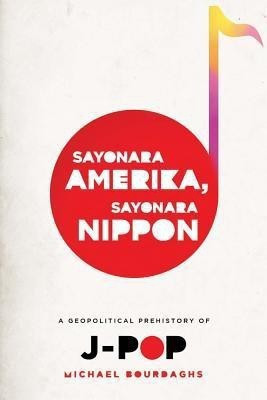
Sayonara Amerika, Sayonara Nippon(English, Hardcover, Bourdaghs Michael)
- Bourdaghs Michael
Paperback & Hardcover deals ―
Amazon IndiaGOFlipkart ₹ 9996SnapdealGOSapnaOnlineGOJain Book AgencyGOBooks Wagon₹1,366Book ChorGOCrosswordGODC BooksGOe-book & Audiobook deals ―
Amazon India GOGoogle Play Books GOAudible GO* Price may vary from time to time.
* GO = We're not able to fetch the price (please check manually visiting the website).
Know about the book -
Sayonara Amerika, Sayonara Nippon(English, Hardcover, Bourdaghs Michael) is written by Bourdaghs Michael and published by Columbia University Press. It's available with International Standard Book Number or ISBN identification 0231158742 (ISBN 10) and 9780231158749 (ISBN 13).
From the beginning of the American Occupation in 1945 to the post-bubble period of the early 1990s, popular music provided Japanese listeners with a much-needed release, channeling their desires, fears, and frustrations into a pleasurable and fluid art. Pop music allowed Japanese artists and audiences to assume various identities, reflecting the country's uncomfortable position under American hegemony and its uncertainty within ever-shifting geopolitical realities. In the first English-language study of this phenomenon, Michael K. Bourdaghs considers genres as diverse as boogie-woogie, rockabilly, enka, 1960s rock and roll, 1970s new music, folk, and techno-pop. Reading these forms and their cultural import through music, literary, and cultural theory, he introduces readers to the sensual moods and meanings of modern Japan. As he unpacks the complexities of popular music production and consumption, Bourdaghs interprets Japan as it worked through (or tried to forget) its imperial past. These efforts grew even murkier as Japanese pop migrated to the nation's former colonies.In postwar Japan, pop music both accelerated and protested the commodification of everyday life, challenged and reproduced gender hierarchies, and insisted on the uniqueness of a national culture, even as it participated in an increasingly integrated global marketplace. Each chapter in Sayonara Amerika, Sayonara Nippon examines a single genre through a particular theoretical lens: the relation of music to liberation; the influence of cultural mapping on musical appreciation; the role of translation in transmitting musical genres around the globe; the place of noise in music and its relation to historical change; the tenuous connection between ideologies of authenticity and imitation; the link between commercial success and artistic integrity; and the function of melodrama. Bourdaghs concludes with a look at recent Japanese pop music culture.
