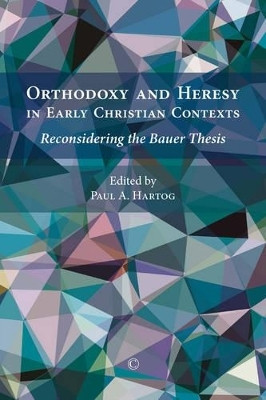
Orthodoxy and Heresy in Early Christian Contexts(English, Electronic book text, unknown)
- unknown
Paperback & Hardcover deals ―
Amazon IndiaGOFlipkart ₹ 3306SnapdealGOSapnaOnlineGOJain Book AgencyGOBooks Wagon₹2,298Book ChorGOCrosswordGODC BooksGOe-book & Audiobook deals ―
Amazon India GOGoogle Play Books ₹32.99Audible GO* Price may vary from time to time.
* GO = We're not able to fetch the price (please check manually visiting the website).
Know about the book -
Orthodoxy and Heresy in Early Christian Contexts(English, Electronic book text, unknown) is written by unknown and published by James Clarke & Co Ltd. It's available with International Standard Book Number or ISBN identification 022790494X (ISBN 10) and 9780227904947 (ISBN 13).
Eighty years ago, Walter Bauer promulgated a bold and provocative thesis about early Christianity. He argued that many forms of Christianity started the race, but one competitor pushed aside the others, until this powerful 'orthodox' version won the day. The victors rewrote history, marginalizing all other perspectives and silencing their voices, even though the alternatives possessed equal right to the title of normative Christianity. Bauer's influence still casts a long shadow on early Christian scholarship. Were heretical movements the original forms of Christianity? Did the heretics outnumber the orthodox? Did orthodox heresiologists accurately portray their opponents? And more fundamentally, how can one make any objective distinction between 'heresy' and 'orthodoxy'? Is such labeling merely the product of socially situated power? Did numerous, valid forms of Christianity exist without any validating norms of Christianity? This collection of essays, each written by a relevant authority, tackles such questions with scholarly acumen and careful attention to historical, cultural-geographical, and socio-rhetorical detail. Although recognizing the importance of Bauer's critical insights, innovative methodologies, and fruitful suggestions, the contributors expose numerous claims of the Bauer thesis (in both original and recent manifestations) that fall short of the historical evidence.
