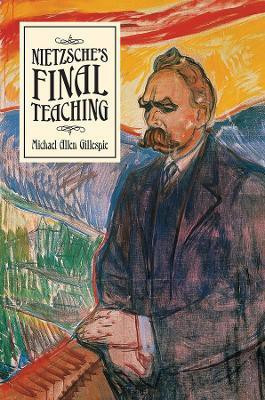
Nietzsche's Final Teaching(English, Hardcover, Gillespie Michael Allen)
- Gillespie Michael Allen
Paperback & Hardcover deals ―
Amazon IndiaGOFlipkart ₹ 3295SnapdealGOSapnaOnlineGOJain Book AgencyGOBooks Wagon₹152Book ChorGOCrosswordGODC BooksGOe-book & Audiobook deals ―
Amazon India GOGoogle Play Books GOAudible GO* Price may vary from time to time.
* GO = We're not able to fetch the price (please check manually visiting the website).
Know about the book -
Nietzsche's Final Teaching(English, Hardcover, Gillespie Michael Allen) is written by Gillespie Michael Allen and published by The University of Chicago Press. It's available with International Standard Book Number or ISBN identification 022647688X (ISBN 10) and 9780226476889 (ISBN 13).
In the seven and a half years before his collapse into madness, Nietzsche completed Thus Spoke Zarathustra, the best-selling and most widely read philosophical work of all time, as well as six additional works that are today considered required reading for Western intellectuals. Together, these works mark the final period of Nietzsche's thought, when he developed a new, more profound, and more systematic teaching rooted in the idea of the eternal recurrence, which he considered his deepest thought. Cutting against the grain of most current Nietzsche scholarship, Michael Allen Gillespie presents the thought of the late Nietzsche as Nietzsche himself intended, drawing not only on his published works but on the plans for the works he was unable to complete, which can be found throughout his notes and correspondence. Gillespie argues that the idea of the eternal recurrence transformed Nietzsche's thinking from 1881 to 1889.It provided both the basis for his rejection of traditional metaphysics and the grounding for the new logic, ontology, theology, and anthropology he intended to create with the aim of a fundamental transformation of European civilization, a "revaluation of all values." Nietzsche first broached the idea of the eternal recurrence in Thus Spoke Zarathustra, but its failure to gain attention or public acceptance led him to present the idea again through a series of works intended to culminate in a never-completed magnum opus. Nietzsche believed this idea would enable the redemption of humanity. At the same time, he recognized its terrifying, apocalyptic consequences, since it would also produce wars of unprecedented ferocity and destruction. Through his careful analysis, Gillespie reveals a more radical and more dangerous Nietzsche than the humanistic or democratic Nietzsche we commonly think of today, but also a Nietzsche who was deeply at odds with the Nietzsche imagined to be the forefather of Fascism. Gillespie's essays examine Nietzsche's final teachinga its components and its political, philosophical, and theological significance.The book concludes with a critical examination and a reflection on its meaning for us today.
