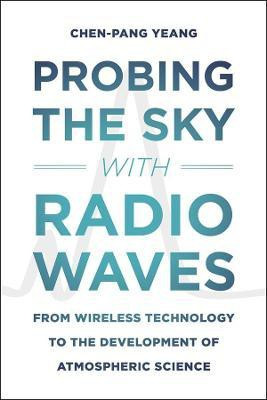
Probing the Sky with Radio Waves(English, Hardcover, Yeang Chen-Pang)
- Yeang Chen-Pang
Paperback & Hardcover deals ―
Amazon IndiaGOFlipkart ₹ 8129SnapdealGOSapnaOnlineGOJain Book AgencyGOBooks Wagon₹1,453Book ChorGOCrosswordGODC BooksGOe-book & Audiobook deals ―
Amazon India GOGoogle Play Books GOAudible GO* Price may vary from time to time.
* GO = We're not able to fetch the price (please check manually visiting the website).
Know about the book -
Probing the Sky with Radio Waves(English, Hardcover, Yeang Chen-Pang) is written by Yeang Chen-Pang and published by The University of Chicago Press. It's available with International Standard Book Number or ISBN identification 022601519X (ISBN 10) and 9780226015194 (ISBN 13).
By the late nineteenth century, engineers and experimental scientists generally knew how radio waves behaved, and by 1901 scientists were able to manipulate them to transmit messages across long distances. What no one could understand, however, was why radio waves followed the curvature of the Earth. Theorists puzzled over this for nearly twenty years before physicists confirmed the zig-zag theory, a solution that led to the discovery of a layer in the Earth's upper atmosphere that bounces radio waves earthward - the ionosphere. In "Probing the Sky with Radio Waves", Chen-Pang Yeang documents this monumental discovery and the advances in radio ionospheric propagation research that occurred in its aftermath. Yeang illustrates how the discovery of the ionosphere transformed atmospheric science from what had been primarily an observational endeavor into an experimental science. It also gave researchers a host of new theories, experiments, and instruments with which to better understand the atmosphere's constitution, the origin of atmospheric electricity, and how the sun and geomagnetism shape the Earth's atmosphere.This book will be warmly welcomed by scholars of astronomy, atmospheric science, geoscience, military and institutional history, and the history and philosophy of science and technology, as well as by radio amateurs and electrical engineers interested in historical perspectives on their craft.
