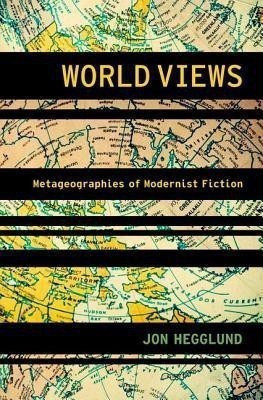
World Views(English, Hardcover, Hegglund Jon)
- Hegglund Jon
Paperback & Hardcover deals ―
Amazon IndiaGOFlipkart ₹ 2871SnapdealGOSapnaOnlineGOJain Book AgencyGOBooks Wagon₹958Book ChorGOCrosswordGODC BooksGOe-book & Audiobook deals ―
Amazon India GOGoogle Play Books GOAudible GO* Price may vary from time to time.
* GO = We're not able to fetch the price (please check manually visiting the website).
Know about the book -
World Views(English, Hardcover, Hegglund Jon) is written by Hegglund Jon and published by Oxford University Press Inc. It's available with International Standard Book Number or ISBN identification 0199796106 (ISBN 10) and 9780199796106 (ISBN 13).
Early in the twentieth century, many novelists and geographers were attempting a similar undertaking: to connect everyday human experience to the large, unseen structures that formed the planet itself. World Views shows how both modernist and postcolonial writers borrowed metaphors and concepts from geography, advancing theories of space, culture, and community within the formal structures of literary narrative. In contrast to the pervasive sense of the globe as a "jigsaw-puzzle" of nations, writers as diverse as Joseph Conrad, E.M. Forster, James Joyce, Jean Rhys, Jamaica Kincaid, and Amitav Ghosh imagined alternative versions of the world that were made up of other spatial building blocks-continents, regions, islands, and boundaries, to name a few. Hegglund argues that much of what scans as modernist experimentation with fictional form is simply another, more geographically based kind of realism: one that pushes the structural and stylistic resources of the novel to account for those abstract spaces beyond immediate, local human experience. Hegglund therefore extends many accounts of modernist and postcolonial studies by showing how writers on all sides of imperial and colonial conflict were concerned not just with the particularities of local place and cultural identity, but also with the overarching structures that could potentially encompass a single, unified earth. Through this sustained attention to both the micro-details of narrative aesthetics and the macro-scale of world geography, World Views adds a new and valuable perspective to both literary and cultural accounts of globalization.
