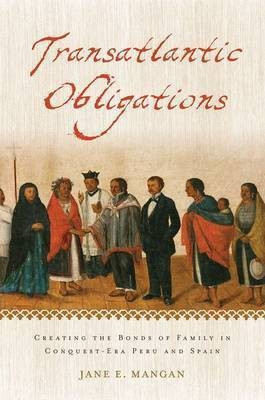
Transatlantic Obligations(English, Paperback, Mangan Jane E.)
- Mangan Jane E.
Paperback & Hardcover deals ―
Amazon IndiaGOFlipkart ₹ 2299SnapdealGOSapnaOnlineGOJain Book AgencyGOBooks Wagon₹1,629Book ChorGOCrosswordGODC BooksGOe-book & Audiobook deals ―
Amazon India GOGoogle Play Books GOAudible GO* Price may vary from time to time.
* GO = We're not able to fetch the price (please check manually visiting the website).
Know about the book -
Transatlantic Obligations(English, Paperback, Mangan Jane E.) is written by Mangan Jane E. and published by Oxford University Press Inc. It's available with International Standard Book Number or ISBN identification 0199768587 (ISBN 10) and 9780199768585 (ISBN 13).
The sixteenth-century changes wrought by expansion of Spanish empire into Peru shaped the ways of being a family in colonial Peru. Even as migration, race mixture, and transculturation took place, family members fulfilled obligations to one another by adapting custom to a changing world. Family began to shift when, from the moment of their arrival in 1532, Spaniards were joined with elite indigenous women in political marriage-like alliances. Almost immediately, a generation of mestizos was born that challenged the hierarchies of colonial society. In response, the Spanish Crown began to promote the marriage of these men and the travel of Spanish women to Peru to promote good customs and even serve as surrogate parents. Other reactions came from wives in Spain who, abandoned by husbands, sought assistance to fulfill family duties. For indigenous families, the pressures of colonialism prompted migration to cities. By mid-century, the increase of Spanish migration to Peru changed the social landscape, but did not halt mixed-race marriages. The book posits that late sixteenth-century cities, specifically Lima and Arequipa, were host to indigenous and Spanish families but also to numerous 'blended' families borne of a process of mestizaje. In its final chapter, the legacies for the next generation reveal how Spanish fathers sometimes challenged law with custom and sentiment to establish inheritance plans for their children. By tracing family obligations connecting Peru and Spain through dowries, bequests, legal powers, and letters, Transatlantic Obligations presents a powerful call to rethink sixteenth-century definitions of family.
