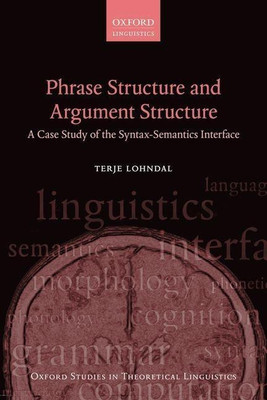
Phrase Structure and Argument Structure(English, Hardcover, Lohndal Terje)
- Lohndal Terje
Paperback & Hardcover deals ―
Amazon IndiaGOFlipkart ₹ 16217SnapdealGOSapnaOnlineGOJain Book AgencyGOBooks Wagon₹90Book ChorGOCrosswordGODC BooksGOe-book & Audiobook deals ―
Amazon India GOGoogle Play Books GOAudible GO* Price may vary from time to time.
* GO = We're not able to fetch the price (please check manually visiting the website).
Know about the book -
Phrase Structure and Argument Structure(English, Hardcover, Lohndal Terje) is written by Lohndal Terje and published by Oxford University Press. It's available with International Standard Book Number or ISBN identification 0199677115 (ISBN 10) and 9780199677115 (ISBN 13).
This book focuses on the relationship between syntax and meaning. Terje Lohndal's core claim is that it is possible to create a transparent mapping from syntax to logical form such that each syntactic Spell-Out domain directly corresponds to a conjunct at logical form. The argument focuses on two domains of grammar - phrase structure and argument structure - and brings together two independently established but seemingly unconnected hypotheses: that verbs do not require arguments, and that specifiers are not required by the grammar. Following the introduction, the second chapter looks in detail at the separation of the verb from its thematic arguments, and presents data from argument structure, reciprocals, and adjectival passives, while the third examines the claim that specifiers do not play a role as the target of various grammatical operations. Chapter 4 then brings these arguments together and proposes a syntax that maps transparently onto logical forms where all thematic arguments are severed from the verb. Moreover, the broader consequences of this approach are outlined in terms of Spell-Out, movement, linearization, thematic uniqueness, and agreement. The book closes with an examination of the relationship between grammatical and conceptual meaning, and a detailed discussion of the nature of compositionality.
