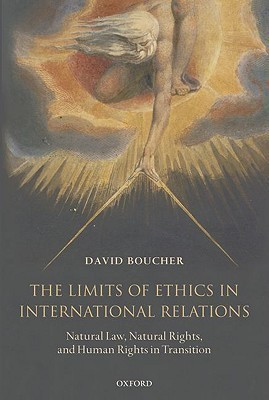
The Limits of Ethics in International Relations(English, Hardcover, Boucher David)
- Boucher David
Paperback & Hardcover deals ―
Amazon IndiaGOFlipkart ₹ 9558SnapdealGOSapnaOnlineGOJain Book AgencyGOBooks Wagon₹221Book ChorGOCrosswordGODC BooksGOe-book & Audiobook deals ―
Amazon India GOGoogle Play Books GOAudible GO* Price may vary from time to time.
* GO = We're not able to fetch the price (please check manually visiting the website).
Know about the book -
The Limits of Ethics in International Relations(English, Hardcover, Boucher David) is written by Boucher David and published by Oxford University Press. It's available with International Standard Book Number or ISBN identification 0199203520 (ISBN 10) and 9780199203529 (ISBN 13).
Ethical constraints on relations among individuals within and between societies have always reflected or invoked a higher authority than the caprices of human will. For over two thousand years Natural Law and Natural Rights were the constellations of ideas and presuppositions that fulfilled this role in the west, and exhibited far greater similarities than most commentators want to admit. Such ideas were the lens through which Europeans evaluated the rest of the world. In his major new book David Boucher rejects the view that Natural Rights constituted a secularisation of Natural Law ideas by showing that most of the significant thinkers in the field, in their various ways, believed that reason leads you to the discovery of your obligations, while God provides the ground for discharging them. Furthermore, the book maintains that Natural Rights and Human Rights are far less closely related than is often asserted because Natural Rights never cast adrift the religious foundationalism, whereas Human Rights, for the most part, have jettisoned the Christian metaphysics upon which both Natural Law and Natural Rights depended. Human Rights theories, on the whole, present us with foundationless universal constraints on the actions of individuals, both domestically and internationally. Finally, one of the principal contentions of the book is that these purportedly universal rights and duties almost invariably turn out to be conditional, and upon close scrutiny end up being 'special' rights and privileges as the examples of multicultural encounters, slavery and racism, and women's rights demonstrate.
