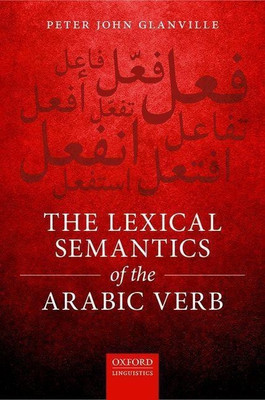
The Lexical Semantics of the Arabic Verb(English, Hardcover, Glanville Peter)
- Glanville Peter
Paperback & Hardcover deals ―
Amazon IndiaGOFlipkart ₹ 3072SnapdealGOSapnaOnlineGOJain Book AgencyGOBooks Wagon₹2,883Book ChorGOCrosswordGODC BooksGOe-book & Audiobook deals ―
Amazon India GOGoogle Play Books GOAudible GO* Price may vary from time to time.
* GO = We're not able to fetch the price (please check manually visiting the website).
Know about the book -
The Lexical Semantics of the Arabic Verb(English, Hardcover, Glanville Peter) is written by Glanville Peter and published by Oxford University Press. It's available with International Standard Book Number or ISBN identification 0198792735 (ISBN 10) and 9780198792734 (ISBN 13).
This book is an investigation of Arabic derivational morphology that focuses on the relationship between verb meaning and linguistic form. Beginning with the ground form, the book offers a comprehensive analysis of the most common verb patterns of Arabic from a lexical semantic perspective. Peter Glanville explains why verbs with seemingly unrelated meanings share the same phonological shape, and analyses sets of words that contain the same consonantal root to arrive at a common abstraction. He uses both contemporary and historical data to explore the semantics of reflexivity, symmetry, causation, and repetition, and argues that the verb patterns of Arabic that express these phenomena have come about as the result of grammaticalization and analogical processes that are common cross-linguistically. The book adopts an approach to morphology in which rule-based derivation has created word patterns and consonantal roots, with the result that in some derivations roots may be extracted from a source word and plugged in to a pattern. It illustrates the semantic relationship between a source word and its derivative, while also offering evidence to support the view of the consonantal root as a morphological object. The volume will be a valuable resource for advanced undergraduate and graduate students of Arabic language and linguistics who are interested in understanding the verb patterns of Arabic, the derivational relationships between words, and the construction of meaning in the mind. It will also appeal to researchers and students in morphology, semantics, historical linguistics, and cognitive linguistics.
