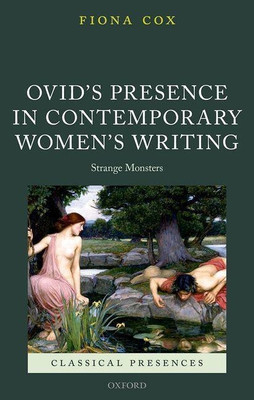
Ovid's Presence in Contemporary Women's Writing(English, Hardcover, Cox Fiona)
- Cox Fiona
Paperback & Hardcover deals ―
Amazon IndiaGOFlipkart ₹ 3182SnapdealGOSapnaOnlineGOJain Book AgencyGOBooks Wagon₹378Book ChorGOCrosswordGODC BooksGOe-book & Audiobook deals ―
Amazon India GOGoogle Play Books GOAudible GO* Price may vary from time to time.
* GO = We're not able to fetch the price (please check manually visiting the website).
Know about the book -
Ovid's Presence in Contemporary Women's Writing(English, Hardcover, Cox Fiona) is written by Cox Fiona and published by Oxford University Press. It's available with International Standard Book Number or ISBN identification 0198779887 (ISBN 10) and 9780198779889 (ISBN 13).
This innovative study analyses the presence of Ovid in contemporary women's writing through a series of insightful case studies of prominent female authors, from Ali Smith, Marina Warner, and Marie Darrieussecq, to Alice Oswald, Saviana Stanescu, and Yoko Tawada. Using Ovid in their engagements with a wide range of issues besetting our twenty-first century world - homelessness, refugees, the financial crisis, internet porn, anorexia, body image - these writers echo the poet's preoccupation in his own work with fleeting fame, shape-shifting, and the dangers of immediate gratification, and make evident that these concerns are not only quintessentially modern, but also peculiarly Ovidian. Moving beyond the concern of second-wave feminism with recovering silenced female voices and establishing a female perspective within canonical works, the volume places particular emphasis on the intersections between Ovid's imaginative universe and the political and aesthetic agenda of third-wave feminism. Focusing on its subjects' socially and politically charged re-shapings, re-imaginings, and receptions of Ovid, it not only demonstrates the extraordinary plasticity of his writing, but also of its myriad re-castings and re-contextualizations within contemporary culture (in terms of genre alone, the works discussed included translations, poetry, plays, novels, short stories, and memoirs). In so doing, it not only offers us a valuable perspective on the work of the selected female authors and a new and vital landmark in the history of Ovidian reception, but also reveals to us an Ovid who remains our contemporary and an enduring source of inspiration.
