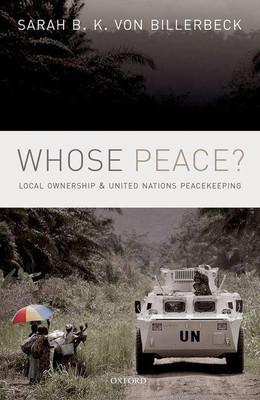
Whose Peace?(English, Hardcover, von Billerbeck Sarah B.K.)
- von Billerbeck Sarah B.K.
Paperback & Hardcover deals ―
Amazon IndiaGOFlipkart ₹ 3434SnapdealGOSapnaOnlineGOJain Book AgencyGOBooks Wagon₹6,898Book ChorGOCrosswordGODC BooksGOe-book & Audiobook deals ―
Amazon India GOGoogle Play Books GOAudible GO* Price may vary from time to time.
* GO = We're not able to fetch the price (please check manually visiting the website).
Know about the book -
Whose Peace?(English, Hardcover, von Billerbeck Sarah B.K.) is written by von Billerbeck Sarah B.K. and published by Oxford University Press. It's available with International Standard Book Number or ISBN identification 0198755708 (ISBN 10) and 9780198755708 (ISBN 13).
Recent years have seen an increasing emphasis on local ownership in United Nations peacekeeping. Advocates assert that it boosts the legitimacy and sustainability of peacekeeping by helping to preserve the principles of self-determination and non-imposition in an activity that can contravene them. However, whether this assertion holds in practice has not been backed up by careful conceptual and empirical analysis. This book fills this gap by mapping the discourse, understandings, and operationalization of local ownership in UN peacekeeping, both from the perspective of the UN and local actors. Drawing on the case of the UN peacekeeping operation in DR Congo and a number of other cases, it shows that despite its regular invocation of local ownership discourse, the UN operationalizes ownership in restrictive ways that are intended to protect the achievement of operational goals but which consequently limit self-determination and increase external imposition on the host country. This gap between the rhetoric and reality of ownership suggests that the UN uses local ownership primarily as a discursive tool for legitimation, one intended to reconcile conflicting normative and operational imperatives that it faces. However, because its actions do not match its rhetoric, the UN's attempts to generate legitimacy through discourse appear to fall flat, particularly in the eyes of local actors, and because of contradictions in the ways that the UN operationalizes local ownership, it also inhibits the achievement of its operational goals as well.
