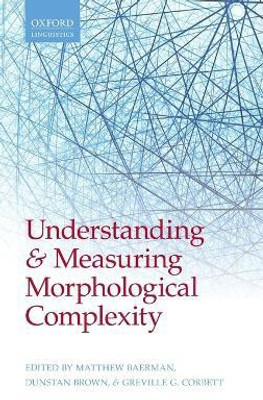
Understanding and Measuring Morphological Complexity(English, Hardcover, unknown)
- unknown
Paperback & Hardcover deals ―
Amazon IndiaGOFlipkart ₹ 3288SnapdealGOSapnaOnlineGOJain Book AgencyGOBooks Wagon₹463Book ChorGOCrosswordGODC BooksGOe-book & Audiobook deals ―
Amazon India GOGoogle Play Books GOAudible GO* Price may vary from time to time.
* GO = We're not able to fetch the price (please check manually visiting the website).
Know about the book -
Understanding and Measuring Morphological Complexity(English, Hardcover, unknown) is written by unknown and published by Oxford University Press. It's available with International Standard Book Number or ISBN identification 0198723768 (ISBN 10) and 9780198723769 (ISBN 13).
This book aims to assess the nature of morphological complexity, and the properties that distinguish it from the complexity manifested in other components of language. Of the many ways languages have of being complex, perhaps none is as daunting as what can be achieved by inflectional morphology: this volume examines languages such as Archi, which has a 1,000,000-form verb paradigm, and Chinantec, which has over 100 inflection classes. Alongside this complexity, inflection is notable for its variety across languages: one can take two unrelated languages and discover that they share similar syntax or phonology, but one would be hard pressed to find two unrelated languages with the same inflectional systems.In this volume, senior scholars and junior researchers highlight novel perspectives on conceptualizing morphological complexity, and offer concrete means for measuring, quantifying and analysing it. Examples are drawn from a wide range of languages, including those of North America, New Guinea, Australia, and Asia, alongside a number of European languages. The book will be a valuable resource for all those studying complexity phenomena in morphology, and for theoretical linguists more generally, from graduate level upwards.
