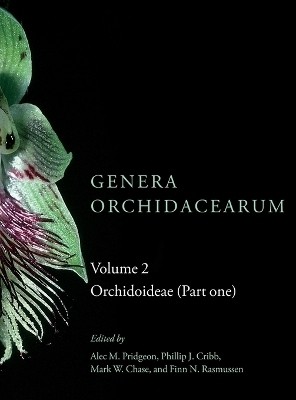
Genera Orchidacearum: Volume 2. Orchidoideae (Part 1)(English, Hardcover, unknown)
- unknown
Paperback & Hardcover deals ―
Amazon IndiaGOFlipkart ₹ 3400SnapdealGOSapnaOnlineGOJain Book AgencyGOBooks WagonGOBook ChorGOCrosswordGODC BooksGOe-book & Audiobook deals ―
Amazon India GOGoogle Play Books GOAudible GO* Price may vary from time to time.
* GO = We're not able to fetch the price (please check manually visiting the website).
Know about the book -
Genera Orchidacearum: Volume 2. Orchidoideae (Part 1)(English, Hardcover, unknown) is written by unknown and published by Oxford University Press. It's available with International Standard Book Number or ISBN identification 0198507100 (ISBN 10) and 9780198507109 (ISBN 13).
Orchidaceae are the largest monocot family and likely the largest plant family in terms of number of species (ca. 20,000), but for a variety of reasons it remains one of the least understood: lack of a fossil record, relative scarcity of active research until recent years, size and geographical distribution of the family, and the largely tropical distribution of most, which hinders access. The early classifications and generic circumscriptions of Lindley (1830-1840), Bentham and Hooker (1883) and Schlechter (1927) relied mainly on morphological characters, especially floral features. The problem with such reliance on floral features at higher levels of classification is that floral morphology is extremely plastic in evolutionary terms, so that unrelated species may have developed similar structures in response to similar selection, particularly pollinator pressures. Such parallelisms are rife in Orchidaceae, so it is necessary to apply more objective criteria and character choices in trying to unravel the complexities of the family's history. Robert L. Dressler's (Phylogeny and Classification of the Orchid Family, Cambridge University Press, 1993) classification introduced characters from pollen, seeds, and anatomy to supplement traditional characters. The recent surge in molecular approaches, especially multigene analyses, combined with several other types of new data, had not only contradicted key elements of Dressler's concepts at higher levels but will result in the recircumscription of many genera. The aim of Genera Orchidacearum is therefore to produce a more robust and natural account of the orchids at the generic level, incorporate the wealth of new molecular data in a truly phylogenetic classification, and identify those areas and taxa that need additional work.
