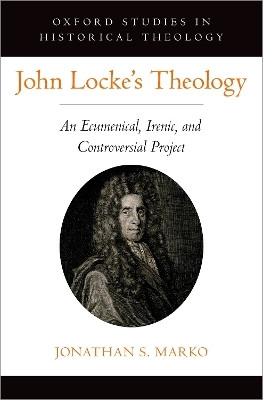
John Locke's Theology(English, Hardcover, Marko Jonathan S.)
- Marko Jonathan S.
Paperback & Hardcover deals ―
Amazon IndiaGOFlipkart ₹ 13099SnapdealGOSapnaOnlineGOJain Book AgencyGOBooks Wagon₹2,340Book ChorGOCrosswordGODC BooksGOe-book & Audiobook deals ―
Amazon India GOGoogle Play Books GOAudible GO* Price may vary from time to time.
* GO = We're not able to fetch the price (please check manually visiting the website).
Know about the book -
John Locke's Theology(English, Hardcover, Marko Jonathan S.) is written by Marko Jonathan S. and published by Oxford University Press Inc. It's available with International Standard Book Number or ISBN identification 019765004X (ISBN 10) and 9780197650042 (ISBN 13).
In John Locke's Theology: An Ecumenical, Irenic, and Controversial Project, Jonathan S. Marko offers the closest work available to a theological system derived from the writings of John Locke. Marko argues that Locke's intent for The Reasonableness of Christianity, his most noted theological work, was to describe and defend his version of the fundamental doctrines of Christianity and not his personal theological views. Locke, Marko says, intended the work to be an ecumenical and irenic project during a controversial time in philosophy and theology. Locke described what qualifies someone as a Christian in simple and irenic terms, and argued for the necessity of Scripture and the reasonableness of God's means of conveying his authoritative messages. The Reasonableness of Christianity could be construed as personal, but mainly in the sense that it puts the burden of understanding Scripture and arriving at theological convictions on the autonomous individual, rejecting the notion that one should base one's doctrinal opinions on so-called authorities. His work was inadvertently controversial partly because then, like today, readers typically failed to make a distinction between Locke's personal and programmatic positions. Marko also points to places in Locke's corpus where he avoids advocating for a particular sectarian position in his treatment of theological doctrines. What is more, it shows why attempting to categorize Locke--a philosopher, theologian, and political scientist all at once--according to traditional Christian paradigms is a dangerous misstep and a difficult scholarly feat.
