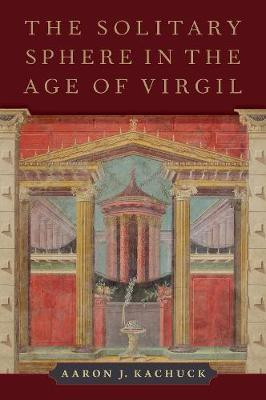
The Solitary Sphere in the Age of Virgil(English, Hardcover, Kachuck Aaron J.)
- Kachuck Aaron J.
Paperback & Hardcover deals ―
Amazon IndiaGOFlipkart ₹ 14182SnapdealGOSapnaOnlineGOJain Book AgencyGOBooks Wagon₹437Book ChorGOCrosswordGODC BooksGOe-book & Audiobook deals ―
Amazon India GOGoogle Play Books GOAudible GO* Price may vary from time to time.
* GO = We're not able to fetch the price (please check manually visiting the website).
Know about the book -
The Solitary Sphere in the Age of Virgil(English, Hardcover, Kachuck Aaron J.) is written by Kachuck Aaron J. and published by Oxford University Press Inc. It's available with International Standard Book Number or ISBN identification 0197579043 (ISBN 10) and 9780197579046 (ISBN 13).
The Solitary Sphere in the Age of Virgil uses an enriched tripartite model of Roman culture-touching not only the public and the private, but also the solitary-in order to present a radical re-interpretation of Latin literature and of the historical causes of this third sphere's relative invisibility in scholarship. By connecting Cosmos and Imperium to the Individual, the solitary sphere was not so much a way of avoiding politics, as a political education in itself. As re-imagined by literature in this age literature, this sphere was an essential space for the formation of the new Roman citizen of the Augustan revolution, and was behind many of the notable features of the literary revolution of Virgil's age: the expansion of the possibilities of the book of poetry, the birth of the literary cursus, new coordinations of cosmology and politics within strictly organized schemes, the attraction of first-person genres, and the subjective style. Through close readings of Cicero's late works and the oeuvres of Virgil, Horace, and Propertius and the works of other authors in the age of Virgil, The Solitary Sphere thus presents a revelatory reassessment of the classicism of classical Roman literature, and contributes to the study of pre-modern culture more generally, especially for traditions that have taken antiquity as too fixed a point in their own literary, religious, and cultural histories.
