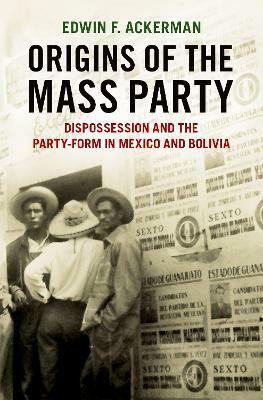
Origins of the Mass Party(English, Hardcover, Ackerman Edwin F.)
- Ackerman Edwin F.
Paperback & Hardcover deals ―
Amazon IndiaGOFlipkart ₹ 11633SnapdealGOSapnaOnlineGOJain Book AgencyGOBooks Wagon₹296Book ChorGOCrosswordGODC BooksGOe-book & Audiobook deals ―
Amazon India GOGoogle Play Books GOAudible GO* Price may vary from time to time.
* GO = We're not able to fetch the price (please check manually visiting the website).
Know about the book -
Origins of the Mass Party(English, Hardcover, Ackerman Edwin F.) is written by Ackerman Edwin F. and published by Oxford University Press Inc. It's available with International Standard Book Number or ISBN identification 0197576508 (ISBN 10) and 9780197576502 (ISBN 13).
In Mexico (1921) and Bolivia (1952), nationalist insurrections with armies largely composed of peasants triumphed over oligarchical regimes. In the aftermath of these uprisings, parties led by members of an urban middle-class intelligentsia adopting a populist agrarian discourse attempted to incorporate this predominantly peasant base. The outcomes of these efforts were, however, radically different.In Origins of the Mass Party, Edwin F. Ackerman tells the stories of the Partido Revolucionario Institucional (PRI) as a mass party in post-revolutionary Mexico (1929-1946), and the attempt but ultimate failure of Bolivia's Movimiento Nacionalista Revolucionario (MNR) (1953-1964) to do the same. As he shows, Mexico's PRI successfully mobilized peasants into party politics, translating the insurrectionary effervescence of the peasantry into organizational incorporation. Bolivia's MNR, in contrast, attempted but failed to undertake a homologous process. To shed light on why this happened, Ackerman examines the historical conditions necessary for the emergence of the mass political parties, offering insights into the persistence of parties over time by linking the economic dispossession that makes it possible to articulate individuals into a political bloc, and the political dispossession that produces professional politicians to undertake articulation and create constituencies. He argues that parties are the predominant form of political mobilization at a global scale, even in an age of dissatisfaction with conventional organization and persistent experimentation with new forms of association. Both comparative and historical in scope, Origins of the Mass Party seeks to show why there is such a strong bond between the party-form and the contemporary world by highlighting the connection between capitalism, modern-state formation, and the party-form.
