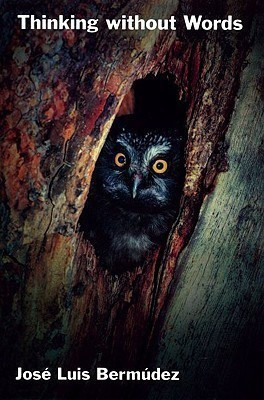
Thinking Without Words(English, Paperback, Bermudez Jose Luis)
- Bermudez Jose Luis
Paperback & Hardcover deals ―
Amazon IndiaGOFlipkart ₹ 4313SnapdealGOSapnaOnlineGOJain Book AgencyGOBooks Wagon₹575Book ChorGOCrosswordGODC BooksGOe-book & Audiobook deals ―
Amazon India GOGoogle Play Books GOAudible GO* Price may vary from time to time.
* GO = We're not able to fetch the price (please check manually visiting the website).
Know about the book -
Thinking Without Words(English, Paperback, Bermudez Jose Luis) is written by Bermudez Jose Luis and published by Oxford University Press Inc. It's available with International Standard Book Number or ISBN identification 0195341600 (ISBN 10) and 9780195341607 (ISBN 13).
Thinking without Words provides a challenging new theory of the nature of non-linguistic thought. Many scientific disciplines treat non-linguistic creatures as thinkers, explaining their behavior in terms of their thoughts about themselves and about the environment. But this theorizing has proceeded without any clear account of the types of thinking available to non-linguistic creatures. One consequence of this is that ascriptions of thoughts to non-linguistic creatures have frequently been held to be metaphorical and not to be taken at face value. Bermudez offers a conceptual framework for treating human infants and non-human animals as genuine thinkers. Whereas existing discussions of thought at the non-linguistic level have concentrated on how such thoughts might be physically realized, Bermudez approaches the problem by considering what is required in explaining behavior in psychological terms. In developing a positive account of non-linguistic thought he shows how the experimental tools used by developmental psychologists and students of animal behavior can be used to give a precise account of the way in which a human infant or non-human animal is representing the world. Much of the book is devoted to exploring the differences between thinking without words and language-based thinking. Bermudez argues that there are clear limits to the expressive power of non-linguistic thought. Nonetheless, he identifies primitive analogues at the non-linguistic level that can be used to explain sophisticated non-linguistic behaviors. Thinking Without Words is the first full-length philosophical study of this important topic. It is written with an interdisciplinary readership in mind and will appeal to philosophers, psychologists, and students of animal behavior.
