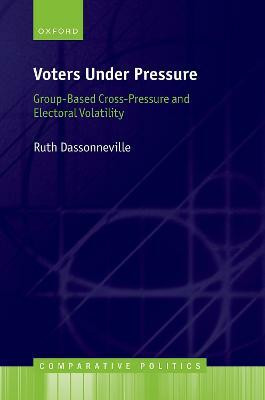
Voters Under Pressure(English, Hardcover, Dassonneville Ruth)
- Dassonneville Ruth
Paperback & Hardcover deals ―
Amazon IndiaGOFlipkart ₹ 15303SnapdealGOSapnaOnlineGOJain Book AgencyGOBooks Wagon₹4,597Book ChorGOCrosswordGODC BooksGOe-book & Audiobook deals ―
Amazon India GOGoogle Play Books GOAudible GO* Price may vary from time to time.
* GO = We're not able to fetch the price (please check manually visiting the website).
Know about the book -
Voters Under Pressure(English, Hardcover, Dassonneville Ruth) is written by Dassonneville Ruth and published by Oxford University Press. It's available with International Standard Book Number or ISBN identification 0192894137 (ISBN 10) and 9780192894137 (ISBN 13).
This book examines changes in voters' electoral choices over time and investigates how these changes are linked to a growth in electoral volatility. Ruth Dassonneville's core argument, supported by extensive empirical data, is that group-based cross-pressures lead to instability in voters' choices. She theorizes that when citizens' socio-demographic characteristics and their membership of social groups do not consistently push them to support one party, but instead lead them to feel cross-pressured between parties, their voting decision process lacks constraint. Voters who are group-based cross-pressured are less likely to feel an attachment to a party, and have less guidance when assessing the state of the economy, when taking positions on issues, or evaluating leaders. The different factors that influence voters' choices, as a result, do not add up to strengthening a preference for one specific party but instead lead a voter to consider different parties. To test this argument, the book makes use of election survey data from eight established democracies that allow the study of voting behaviour and its correlates over several decades. These data are complemented with data from the European Election Studies project and from election study panels. The book shows that group-based cross-pressures are an important source of instability as they affect the extent to which citizens' voting decision process is structured. This is evident from the fact that cross-pressured voters are more ambivalent between parties, make their voting decision later, and are more likely to switch parties from one election to the next.Comparative Politics is a series for researchers, teachers, and students of political science that deals with contemporary government and politics. Global in scope, books in the series are characterized by a stress on comparative analysis and strong methodological rigour. The series is published in association with the European Consortium for Political Research. For more information visit: www.ecprnet.eu.The series is edited by Nicole Bolleyer, Chair of Comparative Political Science, Geschwister Scholl Institut, LMU Munich and Jonathan Slapin, Professor of Political Institutions and European Politics, Department of Political Science, University of Zurich.
