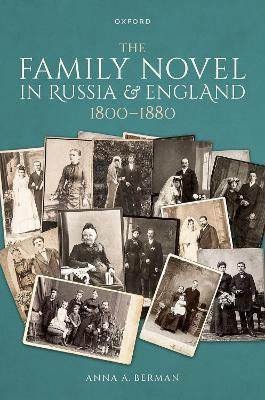
The Family Novel in Russia and England, 1800-1880(English, Hardcover, Berman Anna A.)
- Berman Anna A.
Paperback & Hardcover deals ―
Amazon IndiaGOFlipkart ₹ 11435SnapdealGOSapnaOnlineGOJain Book AgencyGOBooks Wagon₹203Book ChorGOCrosswordGODC BooksGOe-book & Audiobook deals ―
Amazon India GOGoogle Play Books GOAudible GO* Price may vary from time to time.
* GO = We're not able to fetch the price (please check manually visiting the website).
Know about the book -
The Family Novel in Russia and England, 1800-1880(English, Hardcover, Berman Anna A.) is written by Berman Anna A. and published by Oxford University Press. It's available with International Standard Book Number or ISBN identification 0192866621 (ISBN 10) and 9780192866622 (ISBN 13).
This book offers a new understanding of the relationship between family structures and narrative structure in the nineteenth-century novel. Comparing Russia and England, it argues that the two nations had fundamentally different conceptions of the family and that these, in turn, shaped the way they constructed plots. The English placed primary value on the vertical, diachronic family axis--looking back to ancestors and head to progeny--while the Russians emphasized the lateral, synchronic axis--family expanding outward in the present from nuclear core, to extended and chosen kin. This difference shaped the way authors plotted consanguineal relations, courtship and marriage, and alternative kinship constructions. Idealizing the domestic sphere and emphasizing family continuity, the English novel made family a conservative force, while Russian novels approached it as a backward site of patriarchal tyranny in desperate need of reform. Russian family plots offered a progressive, liberalizing push toward new, nontraditional family constructions. The book's comparative approach calls for a re-evaluation of reigning theories of the novel, theories that are based on the linear English family model and cannot accommodate the more complex, Russian alternative. It reveals where these theories fall short, explains the reasons for their shortcomings, and offers a new way of conceptualizing family's role in shaping the nineteenth-century novel. Classics from Dickens, Eliot, and Trollope, to Dostoevsky, Tolstoy, and Turgenev are contextualized in the broader literary landscape of their day, and Russia's great women writers regain their rightful place alongside their male counterparts as the book draws together family history, literary analysis, and novel theory.
