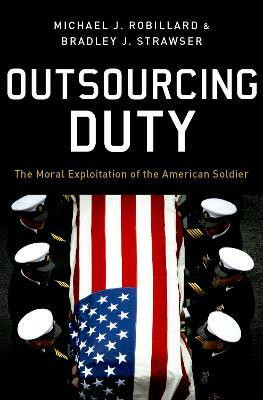
Outsourcing Duty(English, Hardcover, Robillard Michael)
- Robillard Michael
Paperback & Hardcover deals ―
Amazon IndiaGOFlipkart ₹ 4928SnapdealGOSapnaOnlineGOJain Book AgencyGOBooks Wagon₹1,365Book ChorGOCrosswordGODC BooksGOe-book & Audiobook deals ―
Amazon India GOGoogle Play Books GOAudible GO* Price may vary from time to time.
* GO = We're not able to fetch the price (please check manually visiting the website).
Know about the book -
Outsourcing Duty(English, Hardcover, Robillard Michael) is written by Robillard Michael and published by Oxford University Press Inc. It's available with International Standard Book Number or ISBN identification 0190671459 (ISBN 10) and 9780190671457 (ISBN 13).
Are contemporary soldiers exploited by the state and society that they defend? More specifically, have America's professional service members disproportionately carried the moral weight of America's war-fighting decisions since the inception of an all-volunteer force? In this volume, Michael J. Robillard and Bradley J. Strawser, who have both served in the military, examine the question of whether and how American soldiers have been exploited in this way. Robillard and Strawser offer an original normative theory of 'moral exploitation'--the notion that persons or groups can be wrongfully exploited by being made to shoulder an excessive amount of moral weight. They make the case that this exploitation accurately describes the relationship between the United States and the members of its military, and offer a thorough and in-depth analysis of some of the exploitative and misleading elements of present-day military recruitment, the moral burdens soldiers often bear, and the stifling effect that a 'Thank You for Your Service' and 'I support the troops' culture has had on serious public engagement about America's ongoing wars. Robillard and Strawser offer a piercing critique of the pernicious divide between military members and the civilians who direct them. They conclude by arguing for several normative and prudential prescriptions to help close this ever-widening fissure between the U.S. and its military, and within the U.S. itself. In so doing, their work gives a much needed and urgent voice to America's soldiers, the other 1%.
