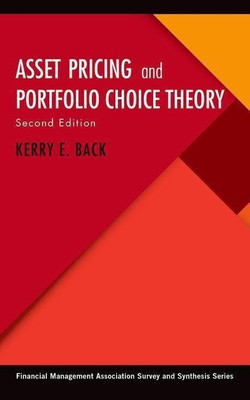
Asset Pricing and Portfolio Choice Theory(English, Hardcover, Back Kerry E.)
- Back Kerry E.
Paperback & Hardcover deals ―
Amazon IndiaGOFlipkart ₹ 19189SnapdealGOSapnaOnlineGOJain Book AgencyGOBooks Wagon₹500Book ChorGOCrosswordGODC BooksGOe-book & Audiobook deals ―
Amazon India GOGoogle Play Books GOAudible GO* Price may vary from time to time.
* GO = We're not able to fetch the price (please check manually visiting the website).
Know about the book -
Asset Pricing and Portfolio Choice Theory(English, Hardcover, Back Kerry E.) is written by Back Kerry E. and published by Oxford University Press Inc. It's available with International Standard Book Number or ISBN identification 0190241144 (ISBN 10) and 9780190241148 (ISBN 13).
In the 2nd edition of Asset Pricing and Portfolio Choice Theory, Kerry E. Back offers a concise yet comprehensive introduction to and overview of asset pricing. Intended as a textbook for asset pricing theory courses at the Ph.D. or Masters in Quantitative Finance level with extensive exercises and a solutions manual available for professors, the book is also an essential reference for financial researchers and professionals, as it includes detailed proofs and calculations as section appendices. The first two parts of the book explain portfolio choice and asset pricing theory in single-period, discrete-time, and continuous-time models. For valuation, the focus throughout is on stochastic discount factors and their properties. A section on derivative securities covers the usual derivatives (options, forwards and futures, and term structure models) and also applications of perpetual options to corporate debt, real options, and optimal irreversible investment. A chapter on "explaining puzzles " and the last part of the book provide introductions to a number of additional current topics in asset pricing research, including rare disasters, long-run risks, external and internal habits, asymmetric and incomplete information, heterogeneous beliefs, and non-expected-utility preferences. Each chapter includes a "Notes and References" section providing additional pathways to the literature. Each chapter also includes extensive exercises.
