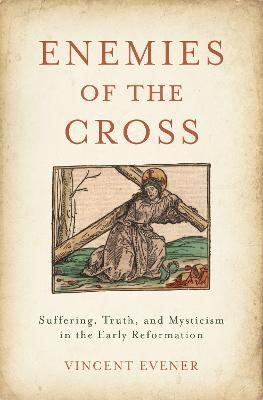
Enemies of the Cross(English, Hardcover, Evener Vincent)
- Evener Vincent
Paperback & Hardcover deals ―
Amazon IndiaGOFlipkart ₹ 15860SnapdealGOSapnaOnlineGOJain Book AgencyGOBooks Wagon₹221Book ChorGOCrosswordGODC BooksGOe-book & Audiobook deals ―
Amazon India GOGoogle Play Books GOAudible GO* Price may vary from time to time.
* GO = We're not able to fetch the price (please check manually visiting the website).
Know about the book -
Enemies of the Cross(English, Hardcover, Evener Vincent) is written by Evener Vincent and published by Oxford University Press Inc. It's available with International Standard Book Number or ISBN identification 0190073187 (ISBN 10) and 9780190073183 (ISBN 13).
Enemies of the Cross examines how suffering and truth were aligned in the divisive debates of the early Reformation. Vincent Evener explores how Martin Luther, along with his first intra-Reformation critics, offered "true" suffering as a crucible that would allow believers to distinguish the truth or falsehood of doctrine, teachers, and their own experiences. To use suffering in this way, however, reformers also needed to teach Christians to recognize false suffering and the false teachers who hid under its mantle. This book contends that these arguments, which became an enduring part of the Lutheran and radical traditions, were nourished by the reception of a daring late-medieval mystical tradition - the post-Eckhartian - which depicted annihilation of the self as the way to union with God. The first intra-Reformation dissenters, Andreas Bodenstein von Karlstadt and Thomas Muentzer, have frequently been depicted as champions of medieval mystical views over and against the non-mystical Luther. Evener counters this depiction by showing how Luther, Karlstadt, and Muentzer developed their shared mystical tradition in diverse directions, while remaining united in the conviction that sinful self-assertion prevented human beings from receiving truth and living in union with God. He argues that Luther, Karlstadt, and Muentzer each represented a different form of ecclesial-political dissent shaped by a mystical understanding of how Christians were united to God through the destruction of self-assertion. Enemies of the Cross draws on seldom-used sources and proposes new concepts of "revaluation" and "relocation" to describe how Protestants and radicals brought medieval mystical teachings into new frameworks that rejected spiritual hierarchy.
